
So you’ve got a killer brand name, a slick logo, or a catchy slogan — and now you’re wondering: “Could I accidentally be stepping on someone else’s toes?” You’re not alone. Trademark infringement is one of the most common legal landmines that startups, small businesses, and even big-name brands trip over every single year in the US. And the kicker? You don’t even have to mean to do it. Innocent mistakes can still land you in federal court.
This guide breaks down everything you need to know about how to avoid trademark infringement — in layman terms, with real cases, real laws, and practical steps you can take right now to keep your brand safe and your wallet intact.
What Is Trademark Infringement? (And Why Should You Care?)
Think of a trademark as your brand’s fingerprint — a word, name, logo, symbol, slogan, or even a color that tells the world, “This is us.” Nike’s swoosh. Apple’s bitten apple. McDonald’s golden arches. These aren’t just pretty designs — they’re legally protected assets.
Under the Lanham Act (15 U.S.C. §§ 1051 et seq.), the main federal trademark law in the US:
The trademark infringement happens when someone uses a mark in commerce that is identical or “confusingly similar” to another registered mark, without permission, in a way that’s likely to confuse consumers about the source of goods or services. To win an infringement claim in court, a plaintiff must prove three things: use, in commerce, and likelihood of confusion.
Here’s the scary part: you don’t need to copy someone’s logo pixel-for-pixel to infringe. If your brand name sounds like another, looks like another, or operates in the same market space, you could be in serious hot water.
Penalties? Oh, they’re real. Courts can award actual damages, the infringer’s profits, treble (triple) damages for willful infringement, attorney’s fees, and even order the destruction of infringing goods. We’re talking potentially hundreds of thousands — or millions — of dollars.
How to Avoid Trademark Infringement: Steps to Follow
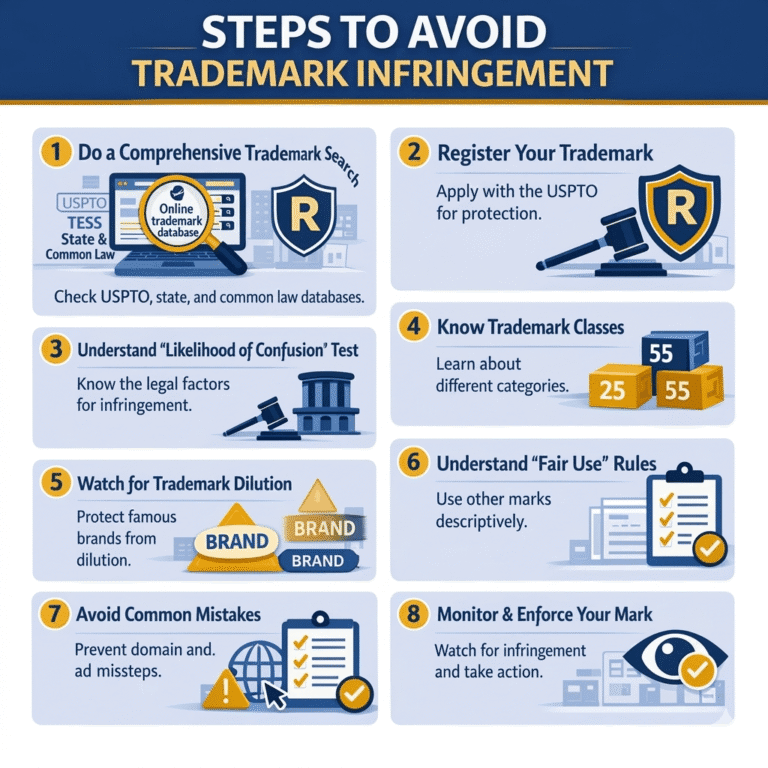
Step 1: Do a Comprehensive Trademark Search Before You Launch
This is the single most important thing you can do, and yet it’s the step most entrepreneurs skip because they’re excited and in a rush. Don’t be that person.
Before you fall in love with your brand name, search it thoroughly across multiple databases:
- USPTO’s TESS (Trademark Electronic Search System) at USPTO.gov — this is the official federal trademark database and your first stop
- State trademark databases — each state has its own registry
- Common law searches — Google, social media, domain registrars, and industry directories. Even unregistered trademarks can have enforceable rights if the owner has been using them in commerce
Pro tip: Don’t just search for exact matches. Search phonetic equivalents, plural forms, misspellings, and design variations. “Spotify” would still conflict with “Spohtify” — courts look at how things sound and how they feel, not just how they’re spelled.
In Interpace Corp. v. Lapp, Inc. (721 F.2d 460, 3d Cir. 1983), the court developed what’s known as the Lapp test — a multi-factor analysis used to determine likelihood of confusion. Factors include:
- the similarity of marks,
- the similarity of goods/services,
- the strength of the mark, evidence of actual confusion, and
- the sophistication of buyers.
This test is still widely used by courts today.
Step 2: Register Your Trademark with the USPTO — Don’t Sleep on This
Using a name without registering it is like building a house on sand. Sure, you have some common law rights from actual use in commerce, but they’re limited to your geographic area and much harder to enforce.
Registering with the USPTO gives you:
- A legal presumption that you own the mark nationwide
- The right to use the ® symbol
- The ability to block similar marks from being registered
- Access to federal courts and stronger legal remedies
- The right to record your mark with US Customs to block counterfeit imports
The registration process involves filing an application, a USPTO examiner reviewing it (which can take 8–14 months), a 30-day public opposition period, and then — if all goes well — registration. It’s not instant, but it’s worth every penny.
Important: Under the Trademark Modernization Act of 2020 (TMA), the USPTO has new tools to cancel fraudulent or abandoned trademarks cluttering the register — making it easier to clear the path for legitimate new marks.
Step 3: Understand the “Likelihood of Confusion” Test — This Is What Courts Look At
Courts don’t just flip a coin. When deciding if infringement happened, they run through a structured analysis. The most commonly cited federal standard comes from Polaroid Corp. v. Polarad Electronics Corp. (2d Cir. 1961), which laid out eight factors, often called the Polaroid factors:
- Strength of the senior mark — How famous is the original brand?
- Similarity of the marks — Do they look, sound, or mean similar things?
- Proximity of the products/services — Are they competing in the same space?
- Likelihood that the senior user will bridge the gap — Will they expand into the junior user’s market?
- Evidence of actual confusion — Have customers already been confused?
- Sophistication of the buyers — Are these informed, careful purchasers or everyday impulse buyers?
- Quality of the junior user’s goods — Could the junior mark harm the senior brand’s rep?
- Good faith of the junior user — Did they knowingly copy?
Bottom line: The more similar your mark is to an existing one, and the more your products overlap, the more likely a court will find infringement.
Step 4: Know the Difference Between Trademark Classes — Don’t Confuse Industries
Here’s something most people don’t know: trademark protection is class-specific. The USPTO uses the Nice Classification system, which divides goods and services into 45 different classes — everything from clothing (Class 25) to software (Class 42) to restaurant services (Class 43).
This means “Delta” can be both an airline brand and a faucet brand — because they’re in completely different classes with no overlap in consumer confusion risk. So when you’re doing your search, focus on your specific class(es) of goods or services, and be strategic about which classes you register in.
Practical example: If you’re launching a fitness app, you’d likely want to register in Class 41 (education and entertainment) and Class 42 (software as a service). Registering only in one class while using the mark in another could leave you exposed.
Step 5: Watch Out for Trademark Dilution — It’s Not Just About Confusion
Most people only think about confusion when they think about trademarks. But there’s another legal theory called trademark dilution under the Federal Trademark Dilution Act (15 U.S.C. § 1125(c)), and it applies to famous marks like Coca-Cola, Google, or Apple.
Dilution comes in two flavors:
- Blurring — using a similar mark in a way that weakens the distinctiveness of a famous mark (imagine “Apple” detergent)
- Tarnishment — associating a famous mark with something distasteful, low-quality, or offensive
The wild thing about dilution? The trademark owner doesn’t have to prove confusion — just that your use weakens their famous brand.
Landmark case: In Jack Daniel’s Properties, Inc. v. VIP Products (2023), the US Supreme Court ruled that VIP Products — which made a dog toy shaped like a Jack Daniel’s bottle as a “parody” — was NOT protected from trademark infringement and dilution claims.
Why? Because VIP was using the Jack Daniel’s marks as a source identifier for its own commercial product, not purely for expressive, non-commercial speech. The court made clear that the parody defense has real limits when money is on the line.
Step 6: Understand What “Fair Use” Actually Means in Trademark Law
Good news: not every use of someone else’s trademark is infringement. The Lanham Act (15 U.S.C. § 1115(b)(4)) includes a fair use defense that lets you use another’s mark under limited circumstances — without permission and without liability.
There are two types of trademark fair use:
- Classic Fair Use:
Using a trademarked word in its plain, descriptive sense — not as a brand identifier. For example, if “Sharp” is trademarked for electronics, a knife company can still describe their blades as having a “sharp edge.” You’re describing the product, not ripping off a brand.
- Nominative Fair Use:
Using someone else’s trademark to refer to their product — not your own. This covers things like comparative advertising, product reviews, news reporting, and criticism.
A car repair shop that says “We fix Toyota vehicles” is using “Toyota” in a nominative fair use context — they’re identifying whose cars they work on, not pretending to be Toyota.
What it does NOT cover: Using another’s mark to sell your own competing products, or in a way that suggests sponsorship or endorsement by the trademark owner.
Step 7: Don’t Trip Up on These Common Trademark Mistakes
These are the blunders that trip up even savvy business folks:
- Using a trademarked name in your domain or URL without permission.
Just because a domain name is available to buy doesn’t mean it’s legally safe to use. This could constitute cybersquatting under the Anti-Cybersquatting Consumer Protection Act (ACPA).
- Bidding on competitor trademarks in Google Ads.
Using a competitor’s trademarked name as a keyword to drive traffic to your site is a legal gray zone — and increasingly, courts and platforms are cracking down on it.
- Assuming foreign trademarks don’t apply in the US.
Under Abitron Austria GmbH v. Hetronic International (US Supreme Court, 2023), the Court confirmed that the Lanham Act does not apply extraterritorially — but foreign brands can still file for US protection. If a European brand is registered with the USPTO, it has full US rights regardless of where it originated.
- Copying “trade dress.”
Trademark protection extends beyond words and logos to the overall look and feel of a product or its packaging — known as trade dress. Think of the distinctive shape of a Coca-Cola bottle or the layout of an Apple Store. Copying these visual elements can be just as legally dangerous as copying a brand name.
Step 8: Monitor Your Own Mark — And Others’ — Continuously
Registering your trademark is not a “set it and forget it” move. You’ve got ongoing responsibilities:
- File a Section 8 Declaration (Affidavit of Use) between years 5 and 6 of registration, confirming you’re still using the mark
- Renew every 10 years (Section 9 Renewal)
- Actively monitor for new filings that conflict with your mark using USPTO alerts, trademark watch services, or tools like TESS
If you don’t enforce your trademark against infringers, you risk losing it to genericide — where a brand name becomes so commonly used that it loses protection. “Escalator,” “Thermos,” and “Aspirin” were all once trademarks before they became generic terms. Don’t let that happen to your brand.
What Happens If You Get a Trademark Infringement Claim?
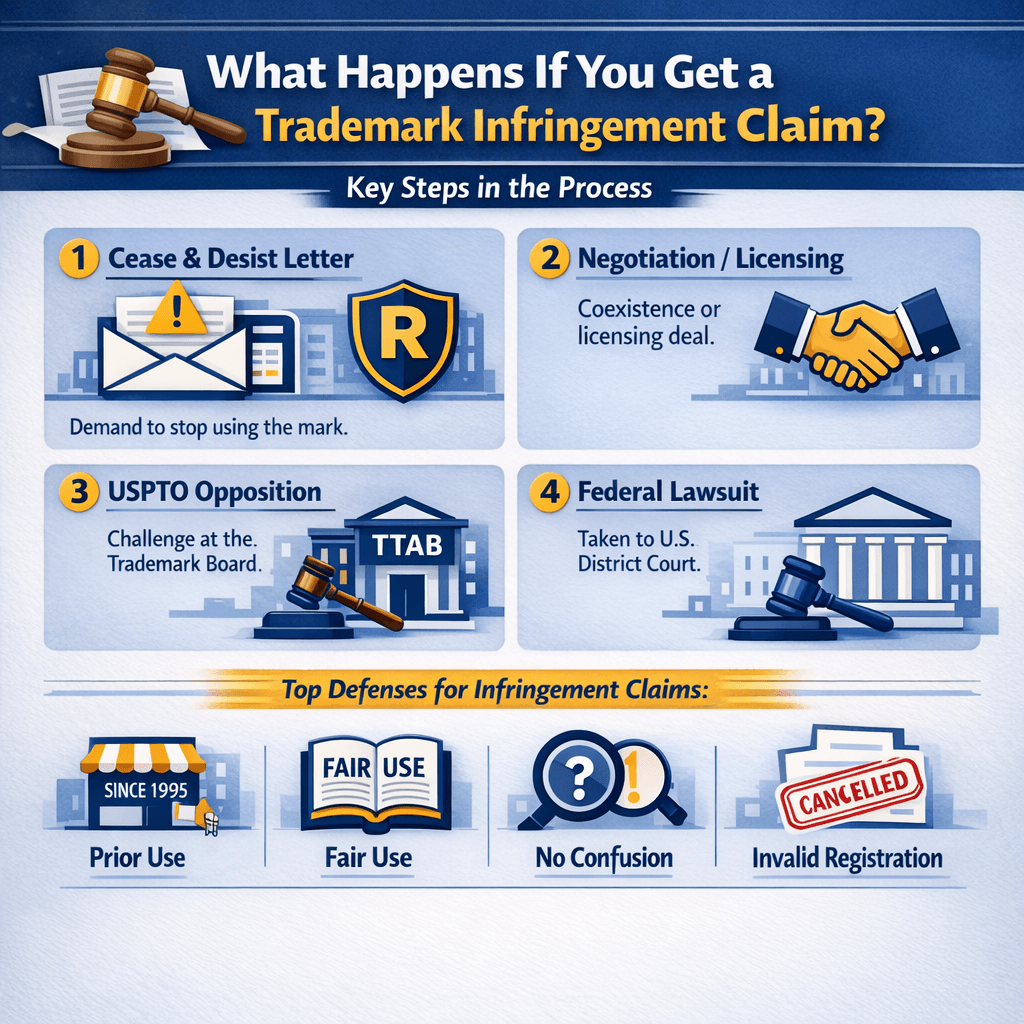
First, don’t panic — and don’t ignore it. Here’s what typically goes down:
- Cease-and-desist letter — This is usually the first move. It formally demands you stop using the mark. It’s not a lawsuit, but it’s a serious legal warning shot.
- Negotiation/licensing — Sometimes parties can work out a coexistence agreement or licensing deal.
- USPTO opposition or cancellation proceeding — If the mark is still pending or registered, the other party can challenge it at the Trademark Trial and Appeal Board (TTAB).
- Federal lawsuit — If talks break down, it goes to federal court. Cases are filed under the Lanham Act in US District Court.
Your best defenses: Prior use (you used the mark first in commerce), fair use, lack of likelihood of confusion, or challenging the validity of the plaintiff’s registration.
The Bottom Line: How to Protect Your Brand and Avoid Trademark Infringement
Trademark law in the US is built around one core principle: protect consumers from confusion and protect businesses from unfair competition. The rules aren’t there to trip you up — they’re there to make sure the marketplace stays honest.
Avoiding trademark infringement is not hard if you check first, choose a unique name, register it, and stay alert. Doing these things saves you time, money, and stress. And if you’re not sure whether something crosses the line — ask a qualified trademark attorney before you find out the hard way in court.
Disclaimer: This article is for informational purposes only and does not constitute legal advice. Trademark law is fact-specific and jurisdiction-dependent. For advice tailored to your situation, consult a licensed US trademark attorney.