
You just Googled your brand name — and some random site with your exact business name is sitting there, ranking above you, selling knockoffs, or worse, just sitting there doing nothing. Sound familiar?
Welcome to the wild world of domain name trademark infringement — one of the fastest-growing legal headaches for businesses of every size in the U.S. Whether you’re a solopreneur who just launched a side hustle or a seasoned brand with years of sweat equity, this is stuff you need to know.
Don’t worry — we’re keeping it real, keeping it simple, and by the end of this article, you’ll know exactly what the law says, what your rights are, and what moves to make. Let’s get into it.
What Is Domain Name Trademark Infringement?
Let’s start with the basics before we get into the juicy legal stuff.
A trademark is basically your brand’s fingerprint — it’s the name, logo, slogan, or symbol that tells the world, “This product or service is ours.” Think Nike’s swoosh, McDonald’s golden arches, or Apple’s bitten apple logo. You can register your trademark with the U.S. Patent and Trademark Office (USPTO) at USPTO.gov, and once you do, you get exclusive rights to use it in commerce.
A domain name is your business’s online street address — like yourcompany.com. You buy domain names through registrars like GoDaddy, Namecheap, or Google Domains. Here’s the thing: domain names are handed out on a first-come, first-served basis. That means anyone can grab any available name — including yours — before you do.
So what is domain name trademark infringement?
It happens when someone registers or uses a web address that is identical to — or confusingly similar to — your trademark in a way that tricks people into thinking the two businesses are connected. Under U.S. law, courts generally hold that a domain name is likely infringing if internet users might think the site is “used, approved, or permitted” by the trademark owner.
Here’s a quick example to make it click: Say you own a brand called SwiftClean Laundry Services and have it trademarked. Now imagine a competitor registers swiftclean-laundry.com and starts stealing your customers. That’s domain name trademark infringement in action — and the law gives you real tools to fight it.
The Crucial Difference: Domain Registration vs. Trademark Rights
Before we go any further, let’s clear up the biggest misconception people have — and it’s one that costs businesses thousands of dollars in avoidable legal battles.
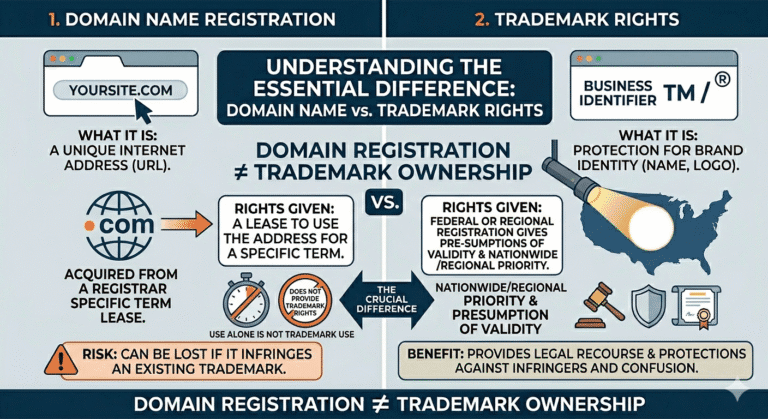
Buying a domain name does NOT give you trademark rights. Period.
A domain name and a trademark are two completely different things. A trademark identifies goods or services as being from a particular source.
Use of a domain name only as part of a web address does not qualify as trademark use — and registration of a domain name with a registrar does not give you any trademark rights. You could even be forced to surrender your domain if it infringes someone else’s trademark rights.
Think of it this way: buying bestpizzaever.com on GoDaddy is like renting a mailbox. It doesn’t mean you own the name “Best Pizza Ever” — you’re just leasing that digital address until someone with a stronger trademark claim shows up.
This is exactly why registering your trademark with the USPTO is so important. Federal registration provides presumptions of validity and nationwide priority — meaning you have legal backup that a domain registration alone can never give you.
The U.S. Laws That Make Domain Name Trademark Infringement a Legal Fight You Can Win
Now here’s where things get powerful. The U.S. has some seriously strong laws protecting trademark owners from domain abuse. Here are the three you absolutely need to know.
1. The Lanham Act
This law is the Foundation of Domain Name Trademark Infringement Law.The Lanham Act (15 U.S.C. §§ 1051–1127) is the big kahuna of U.S. trademark law.
It protects both registered trademarks and unregistered common-law marks against unauthorized uses that cause consumer confusion.
- Under 15 U.S.C. § 1114, anyone who uses a registered mark in commerce without permission can be liable for trademark infringement.
- And under § 1125(a), even unregistered marks are protected against false designations of origin. So even if you haven’t officially registered your trademark yet, you might still have a case — as long as you’ve been using your mark consistently in business.
2. The Anti-cybersquatting Consumer Protection Act (ACPA)
Passed in 1999, the ACPA (15 U.S.C. § 1125(d)) was created for one specific reason: to stop cybersquatters dead in their tracks. The Law Built Specifically for Domain Name Trademark Infringement.
The law was designed to thwart individuals who register internet domain names containing trademarks with no intention of creating a legitimate website, but instead plan to sell the domain name to the trademark owner or a third party — often at an outrageous markup.
Under the ACPA, you can win statutory damages ranging from $1,000 to $100,000 per domain name registered in bad faith. That’s per domain.
So if someone squatted on 10 of your brand variations? Do the math — that’s potentially a million dollars on the table.
3. Federal Trademark Dilution Laws
This law basically protects Famous Brands from Domain Name Trademark Infringement. Even if there’s no direct competition between two businesses, using a famous brand’s name in a domain name can still lead to legal trouble under federal trademark dilution laws.
So if you register disney-cheaptickets.com even to sell something totally unrelated to movies, Disney can still come after you. Fame has privileges in trademark law.
The 4 Types of Domain Name Trademark Infringement You Need to Recognize
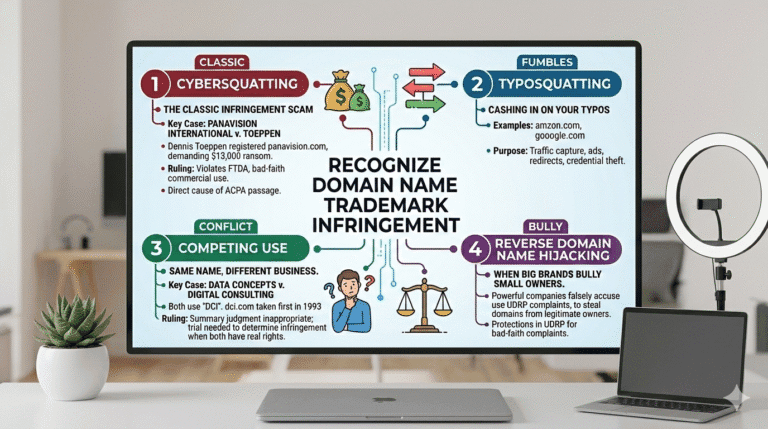
Not all domain name trademark infringement looks the same. Here are the four main types — and they’re more common than you’d think.
Cybersquatting — The Classic Domain Name Trademark Infringement Scam
This is the OG move. Someone registers your brand’s domain name before you do — usually right when your brand starts getting some buzz — and then tries to flip it back to you at a wild price. Imagine finally launching your business only to find out yourbrand.com is owned by some guy demanding $50,000 for it.
That’s cybersquatting, and it’s a federal crime under the ACPA.
Panavision International, L.P. v. Toeppen (9th Cir. 1998):
This is the case that basically started it all. Dennis Toeppen — one of the most notorious domain squatters of the early internet — registered panavision.com and then had the nerve to ask Panavision (yes, the famous camera company) for $13,000 to get it back.
The Ninth Circuit Court of Appeals ruled that Toeppen’s bad‑faith registration violated the Federal Trademark Dilution Act, calling it a commercial use of the trademark for profit. The case was so outrageous that it directly pushed Congress to pass the ACPA the very next year.
The takeaway: Holding a domain name for ransom isn’t just sleazy — it’s illegal.
Typosquatting — Cashing In on Your Typos
Ever mistype a website address and end up somewhere sketchy? That’s probably typosquatting. Cybercriminals register intentional misspellings of popular brand domains — think amzon.com or gooogle.com — to capture traffic from users who fumble the keyboard.
The infringing site might show ads, steal credentials, or just redirect your potential customers to a competitor.
This is a particularly nasty form of domain name trademark infringement because the victim is often the customer, not just the brand.
Competing Use — Same Name, Different Business
Here’s where it gets complicated. The U.S. trademark system is divided by industry and geography — meaning two different companies can legally use the same name in different sectors.
For example, “United” is used as a trademark by United Airlines, United Van Lines, and United Way — all perfectly legal. But there’s only one united.com, and only one business can have it.
Let’s understand this with the example of a case law named:
Data Concepts, Inc. v. Digital Consulting, Inc. (6th Cir.).
- In this case both companies had legitimate trademark rights to the initials “DCI.” Data Concepts grabbed dci.com first in 1993.
- When Digital Consulting tried to claim it, the Sixth Circuit ruled that a full trial was needed to determine infringement — because summary judgment is rarely appropriate when two parties both have real trademark rights.
This case shows that domain name trademark infringement isn’t always black and white. Sometimes it’s two innocent parties fighting for the same piece of digital real estate.
Reverse Domain Name Hijacking — When Big Brands Bully Small Owners
This one flips the script. A powerful company falsely accuses a small, legitimate domain owner of trademark infringement just to steal their domain for free. It’s less common, but it happens — and ICANN’s UDRP process has protections against it.
If a company files a UDRP complaint knowing it has no real case, they can be found guilty of reverse domain name hijacking.
What Courts Look at to Decide Domain Name Trademark Infringement Cases
Not every similar‑looking domain equals infringement. Courts and UDRP panels look for specific factors to decide whether domain name trademark infringement actually occurred — especially signs of bad‑faith intent to profit under the ACPA.
Red Flags: Signs of Bad Faith
- The registrant tries to sell the domain to the trademark owner for profit with no real business use.
- Fake or misleading contact information during registration.
- A pattern of registering domains matching other brands — classic cybersquatting.
- Redirecting the domain to competitors or parking ads that compete with the trademark owner.
- No legitimate website or business ever attached to the domain.
Good‑Faith Indicators (Defenses)
- The registrant has their own legitimate trademark or IP rights.
- The domain matches the registrant’s legal name or long‑used nickname.
- The site is a genuine gripe site or fair commentary — protected under the First Amendment.
Case Example: Mayflower Transit v. Prince (2004)
The moving company Mayflower Transit sued a customer who registered mayflowervanline.com to express his frustration with their service.
Even though Mayflower’s trademark was distinctive and the domain was confusingly similar, the court found the defendant had a bona fide noncommercial use — he just wanted to vent.
The court concluded: “Defendant’s motive for registering the disputed domain names was to express his customer dissatisfaction.” No bad faith, no cybersquatting.
This case is a great reminder that domain name trademark infringement law has limits — and free speech still matters.
How to Fight Domain Name Trademark Infringement: 4 Essential Moves
If someone’s squatting on your domain or mimicking your brand online, here’s how to fight back.
Move 1: Send a Cease‑and‑Desist Letter
Start strong with a formal letter from a trademark attorney. Most infringers back off fast when faced with real legal pressure — it’s cheaper than a lawsuit and shows you mean business.
Move 2: File a UDRP Complaint Through ICANN
Use the Uniform Domain Name Dispute Resolution Policy (UDRP) for quick, affordable action. Prove the domain is confusingly similar, the owner lacks rights, and it was registered in bad faith — win all three, and the domain transfers to you within weeks.
Move 3: Sue Under the ACPA
For damages, file under the Anti‑Cybersquatting Consumer Protection Act (ACPA). Courts can award up to $100,000 per infringing domain. Even re‑registering a bad‑faith domain counts as infringement — as confirmed in Prudential v. Shenzhen Stone Network (2023).
Move 4: Negotiate a Settlement
Sometimes buying the domain is faster and cheaper than litigation. If the owner isn’t acting in bad faith, a fair‑market deal can save time and money.
How to Protect Your Brand from Domain Name Trademark Infringement
Prevention is 100× cheaper than litigation. Follow this proactive game plan to safeguard your brand.
Step 1 — Register Your Trademark with the USPTO
Federal registration gives you nationwide protection and legal presumption of ownership. It’s your first line of defense against domain name trademark infringement.
Step 2 — Lock Down Domain Variations
Buy all major versions of your domain — .com, .net, .org, .co, and common misspellings. It’s inexpensive insurance against cybersquatters.
Step 3 — Set Up Brand Monitoring Alerts
Use Google Alerts, the USPTO’s TESS database, or paid tools like Thomson CompuMark to catch conflicting trademarks or domains early.
Step 4 — Run a Trademark Clearance Search
Before choosing a domain, search the USPTO database and Google to avoid conflicts. A quick check can prevent costly disputes later.
Step 5 — Register Internationally if You Operate Globally
Trademark protection doesn’t stop at borders. Use the Madrid Protocol via WIPO to secure your rights worldwide.
Quick Reference: UDRP vs. ACPA — Which One Should You Use?
UDRP | ACPA Lawsuit | |
Speed | Weeks | Months to years |
Cost | Lower | Higher |
Remedy | Domain transfer or cancellation only | Transfer + money damages up to $100K per domain |
Jurisdiction | International | U.S. federal courts |
Best for | Quick domain recovery | Persistent squatters, financial damages |
Bad faith required? | Yes | Yes |
The Bottom Line on Domain Name Trademark Infringement
Here’s the cold, hard truth: in today’s digital-first economy, your domain name is your storefront, your handshake, and your reputation — all rolled into one URL. Domain name trademark infringement isn’t just a legal headache; it’s a real business threat that can cost you customers, revenue, and years of brand-building work.
The good news? U.S. law — through the Lanham Act, the ACPA, and the UDRP — gives trademark owners some serious firepower.
Recent cases like Prudential v. Shenzhen (2023) prove that courts are cracking down harder than ever, closing loopholes and expanding protections for brand owners even across international borders.
Your action plan is simple:
- Register your trademark with the USPTO
- Lock down your domain variations proactively
- Monitor your brand online regularly
- Act fast if you spot infringement — the longer you wait, the messier it gets
And if someone’s already squatting on your name? Don’t panic. Send that cease and desist, file that UDRP, and if needed — see them in federal court.
Your brand is worth protecting. Don’t let someone else profit from what you built.
This article is for informational purposes only and does not constitute legal advice. For specific legal matters related to domain name trademark infringement, consult a licensed U.S. trademark attorney. For official resources, visit USPTO.gov and ICANN.org.