
Imagine spending hours creating an original photograph, writing an article, designing a logo or producing a video. Then, one day, you discover that someone else is using your work on their website, social media account or online store without asking your permission.
Your first question may be: Can I sue someone for copyright infringement?
The answer is yes, in certain circumstances. However, simply creating a work or finding it being used without permission does not automatically give everyone the right to file a copyright infringement lawsuit.
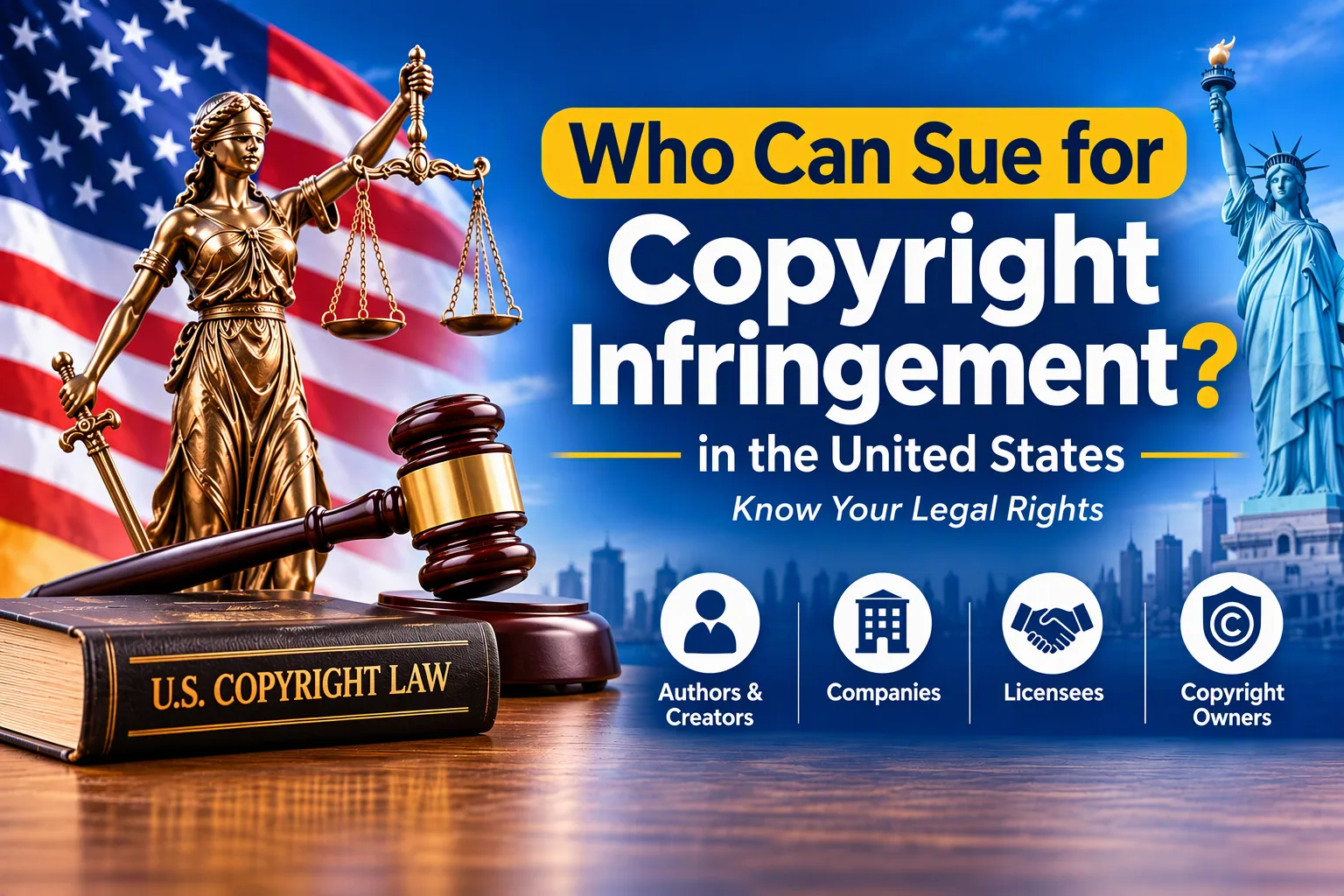
Under US copyright law, the right to sue generally belongs to the legal or beneficial owner of the exclusive copyright right that has been infringed. This could be an individual creator, a business or someone who has received ownership of an exclusive right.
Let’s look at who can file a copyright infringement lawsuit in the United States, what rights different people have and what you should check before taking legal action.
Who Can Sue for Copyright Infringement in the US?
The starting point is Section 501(b) of the US Copyright Act (17 U.S.C. § 501(b)).
It allows the legal or beneficial owner of an exclusive right under copyright to bring an infringement action for a violation of that particular right, subject to the applicable legal requirements.
You can read the official text of Section 501 of the US Copyright Act.
In practical terms, the people who may be entitled to sue include:
The original copyright owner.
An author who still owns the relevant copyright rights.
A company that owns the copyright.
A person or business that has received a valid transfer of copyright ownership.
The owner of a particular exclusive copyright right, such as an exclusive licensee.
But what does this mean in real-life situations?
1.Can I Sue Someone If I Created the Work Myself?
Generally, yes. If you created an original photograph, article, video, illustration, song or other copyrightable work, you are usually its first copyright owner.
For example, suppose you are a freelance photographer. You take an original photograph and upload it to your portfolio website. A business then downloads the photograph and uses it in its advertising without your permission.
You may have the right to sue for copyright infringement because you own the copyright in the photograph.
The same principle can apply to writers, musicians, artists, filmmakers and other creators.
Under Section 201(a) of the US Copyright Act, copyright initially belongs to the author or authors of a work.
However, there is an important exception: work made for hire.
If you create a work as an employee within the scope of your employment, your employer may own the copyright. Certain commissioned works can also qualify as works made for hire, but only when the statutory conditions are satisfied.
So, if you created something for a client or employer, check your contract before assuming that you own the copyright.
2. Can a Company Sue for Copyright Infringement?
Yes. A business can file a copyright infringement lawsuit if it owns the copyright or the specific exclusive right that has been infringed.
Consider this example.
A company hires a designer to create original product photographs for its online store. The agreement properly transfers copyright ownership to the company. Later, another business copies those photographs and uses them on its own website.
In this situation, the company that owns the copyright may be able to sue.
Copyright ownership can be transferred through a valid agreement. Under Section 204 of the US Copyright Act, a transfer of copyright ownership generally requires a written instrument or other written document signed by the owner of the rights being transferred, or an authorised agent.
This is why businesses should have clear written agreements with freelancers, photographers, writers and designers. Paying someone to create content does not, by itself, necessarily transfer copyright ownership.
3. Can an Exclusive Licensee Sue for Copyright Infringement?
Yes, an exclusive licensee may be able to sue if the agreement gives them ownership of the particular exclusive copyright right that has been infringed.
For example, imagine a publisher receives an exclusive right to distribute a book in a particular territory. Another company starts distributing the same book in violation of that exclusive right.
The publisher may have grounds to bring a copyright infringement claim, depending on the agreement and the rights involved.
The important question is not simply whether the agreement calls itself an exclusive licence. You need to examine exactly which rights were transferred, for how long and in which territory.
4. Can I Sue If I Only Have Permission to Use Someone Else's Work?
Usually, no. Having permission to use copyrighted material does not automatically give you the right to sue someone else for copyright infringement.
For example, a photographer gives five different businesses permission to use the same photograph. These businesses receive non-exclusive licences.
If another company copies the photograph without permission, the five businesses do not automatically have the right to file copyright infringement lawsuits simply because they were authorised to use it.
The copyright owner or another qualifying owner of the relevant exclusive right would generally be the person entitled to bring the claim.
This is an important distinction when reviewing a copyright licence or drafting a licensing agreement.
5. What If I Transferred My Copyright to Someone Else?
This is another situation that creators often overlook.
Suppose you wrote a book and transferred copyright ownership to a publishing company. Later, someone reproduces the book without permission.
Can you still sue?
It depends on what rights you transferred and whether you retained a legally recognised ownership interest.
For example, an author who transfers legal title but retains a right to receive royalties may, in certain circumstances, qualify as a beneficial owner under Section 501(b).
However, if you transferred all relevant rights and retained no qualifying ownership interest, you generally cannot sue simply because you originally created the work.
Always review the copyright assignment agreement before deciding whether you can bring a claim.
Do I Need to Register My Copyright Before Filing a Lawsuit?
This is one of the most important questions for anyone considering a copyright infringement lawsuit in the United States.
Copyright protection generally begins automatically when an original work is created and fixed in a tangible form. You do not have to register it for copyright protection to exist.
However, there is a difference between owning copyright and being able to file a lawsuit.
Under Section 411(a) of the US Copyright Act, registration or preregistration is generally required before filing a civil infringement action involving a US work, subject to statutory exceptions.
The US Supreme Court explained this requirement in Fourth Estate Public Benefit Corp. v. Wall-Street.com, LLC, 586 U.S. 296 (2019). The Court held that, in general, registration occurs when the Copyright Office registers the work, not merely when an application is submitted.
You can read the Supreme Court’s decision in Fourth Estate v. Wall-Street.com.
Therefore, if someone has copied your work, check its registration status before filing a lawsuit. Do not assume that submitting an application alone is enough.
What Evidence Should I Keep If Someone Copies My Work?
Finding your work on another website is frustrating, but before contacting the other party or considering legal action, preserve the available evidence.
Here is a practical checklist:
- Keep the original photograph, article, video, design or other creative file.
- Save drafts, source files and creation records.
- Keep your copyright registration certificate, if available.
- Preserve signed copyright assignment and licensing agreements.
- Take screenshots of the allegedly infringing material.
- Record the website address and the date you found the material.
- Save relevant emails and messages with the person or business involved.
For example, if someone has copied your photograph and placed it on an online store, save screenshots showing the photograph and the page where it appears. Keep the original photograph as well.
These records may help establish what you created, who owns the relevant rights and how the material was allegedly used.
How Long Do I Have to Sue for Copyright Infringement?
You should not wait too long before exploring your legal options.
Under Section 507(b) of the US Copyright Act, a civil action generally must be commenced within three years after the claim accrued.
However, dete
Frequently Asked Questions About Copyright Infringement Lawsuits
Yes, if you own the relevant exclusive copyright right and the other legal requirements for filing a lawsuit are satisfied. You should also establish that the use was not authorised or otherwise legally permitted.
Copyright protection can exist without registration. However, Section 411(a) generally requires registration or preregistration before filing a federal infringement lawsuit involving a US work, subject to statutory exceptions.
Yes, if the business owns the copyright in the website content or the relevant exclusive rights. It should establish ownership and gather evidence of the unauthorised use.
Yes. For example, authors who jointly create a work may be joint copyright owners. Copyright ownership can also be divided so that different people own different exclusive rights.
Under Section 507(b) of the US Copyright Act, a civil action must generally be commenced within three years after the claim accrues. Determining when a claim accrues can depend on the circumstances.
Final Thoughts: Can You File a Copyright Infringement Lawsuit?
If someone has copied your original work, the first thing to establish is who actually owns the copyright or the exclusive right that was infringed.
You may have the right to sue as an individual creator, a business, a copyright assignee or a qualifying exclusive licensee. However, your agreements, ownership records and registration status can make a significant difference.
Before filing a copyright infringement lawsuit, review your ownership documents, preserve evidence and check the applicable requirements under US copyright law.
If you need help understanding copyright ownership, preparing copyright-related documents or drafting a copyright takedown notice, you can contact IPRInfoWorld to discuss your requirements.