
Imagine spending a whole weekend typing in prompts, tweaking variables, and trying to get the perfect image or text out of Midjourney or ChatGPT. Finally, you get an awesome asset for your client’s new digital campaign. You think, “This is it. This is mine.”
You post it online. Then—boom. You find out a competitor copied it, used it in their own ads, and is actively stealing your traffic.
Here’s the kicker: Under current US law, you might have zero legal recourse.
Look, that’s the high-stakes reality facing content creators, agencies, and entrepreneurs today. If you’re building your business on raw AI generation, you’re building on quicksand. The biggest legal storm of the decade is raging right now over one simple question: who owns AI-Generated content? If you assume you do, you’re making a dangerous gamble with your business assets.
The Bottom Line Up Front (BLUF)
Current US Copyright Law is incredibly clear: Pure AI output cannot be copyrighted. By default, is ai work in the public domain? Yes. The law protects the human, not the computer script. Your competitor can copy your unedited AI assets pixel-for-pixel, and there’s legally nothing you can do about it.
Thaler v Perlmutter Copyright: The 2026 Supreme Court Decision That Changed Everything
The battle lines were drawn clearly in Thaler v. Perlmutter.
- Dr. Stephen Thaler, a computer scientist, developed a generative AI system called the “Creativity Machine.”
- In 2019, he submitted a copyright registration application to the U.S. Copyright Office for an artwork titled “A Recent Entrance to Paradise,” which the AI created autonomously.
- On the application, Thaler listed the Creativity Machine as the sole author and himself only as the owner/claimant.
- He explicitly stated the work was made “autonomously by machine” with no human creative input.
- The U.S. Copyright Office rejected the application, citing its long‑standing rule that only human authors can hold copyright.
The Claim:
Thaler argued that:
The human‑authorship requirement is unconstitutional and outdated.
His AI should be recognized as the author, or alternatively, he should own the copyright under the work‑made‑for‑hire doctrine.
He claimed the Copyright Office’s decision was arbitrary and contrary to law.
What the Courts Decided:
The Court of Appeals for the D.C. Circuit affirmed the Copyright Office’s denial. Key points:
The Copyright Act of 1976 requires that all works be authored “in the first instance by a human being.”
Machines cannot own property, have lifespans, heirs, or intent — all attributes the Act assumes of authors.
The AI itself cannot be an author, and Thaler’s argument that he was the author by operating the AI was waived because he didn’t raise it earlier.
The court emphasized that AI can assist, but human creative input must dominate for copyright protection.
On March 2, 2026, the U.S. Supreme Court refused to hear the appeal (denied certiorari), cementing this as the law of the land for now.
This decision reinforces the human authorship requirement and gives creators crystal-clear guidance: Pure AI output gets no protection.
Also Read: First Ever AI-Generated Image Receive Copyright Protection in U.S.
U.S. Copyright Office Official Guidance on AI-Generated Content
If you want to know exactly how the federal government views your tech stack, you don’t have to guess. The ultimate legal source of reference is the U.S. Copyright Office (USCO) Artificial Intelligence Initiative.
Following a massive review that pulled in over 10,000 public comments, the USCO began issuing its comprehensive, multi-part flagship report titled Copyright and Artificial Intelligence.
- The Federal Blueprint: In Part 2: Copyrightability (a formal report from the Register of Copyrights), the USCO broke down the exact level of human work needed to get a copyright.
- The Prompter’s Dilemma: The report directly addresses prompt engineering. The USCO ruled that merely typing in highly detailed text prompts does not make you an author. Why? Because prompts function exactly like “ideas”. Under traditional US copyright law, general ideas have been excluded from protection for over a century.
Basically, the official stance from the Register of Copyrights is clear: Existing principles of copyright law are flexible enough to handle AI. The technology has changed, but the baseline hasn’t: copyright requires original human expression, not a machine executing commands.
Can AI-Generated Content Be Copyrighted? Human Authorship Requirements Explained
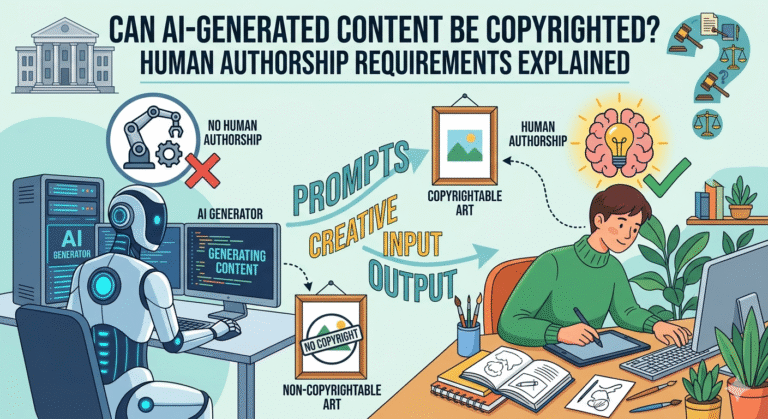
So the machine can’t own it. Fair enough. That leaves us with the gray area that is absolutely critical to your content strategy: Can ai generated content be copyrighted if a human is steering the ship?
Yes—but only if you can prove that you, the human, provided substantial, creative expression that dominated the final product. The USCO calls this the “Human Continuum,” and it’s an incredibly narrow tightrope to walk.
Hired Artist Analogy: Why AI Prompts Alone Don’t Create Copyright
To understand why the USCO denies prompt-heavy work, think of your AI tool like a highly skilled, human painter.
If you walk into a studio and tell a master painter, “Paint me a picture of a futuristic astronaut riding a neon horse in a cyberpunk city,” and that artist creates a masterpiece, you do not own the copyright. The painter does. Why? Because you only supplied the idea. The painter made the expressive choices—the brush strokes, the shading, the exact composition.
Under current US guidance, AI text prompts are legally seen as general instructions given to a hired painter. The prompt itself isn’t “expression”—it’s just direction.
This is exactly what played out in Allen v. Perlmutter, the famous case involving Jason M. Allen’s AI image, “Théâtre D’opéra Spatial.” Even though Allen input over 624 prompts and spent weeks adjusting variables, the USCO denied his registration. They ruled that the AI was still responsible for selecting and arranging the core visual look. The human input just wasn’t substantial enough
Hybrid AI Art Legal Battles: Latest 2026 Cases
Newer cases continue to narrow the defense. In May 2026, the USCO was sued again in Suryast U.S. Enterprises v. Perlmutter. This case involves a photographer who took an original sunset photo he shot himself, and used an AI app called RAGHAV to stylize it using Van Gogh’s The Starry Night as a reference.
The Copyright Office rejected the final blended image, stating that the AI app—not the human—was responsible for deciding how to blend the pixels. The photographer is now fighting this in court, arguing his original base photo should give him the copyright.
Because of this, the USCO will usually only grant a “thin copyright.” This means if you create an AI comic book, you can copyright the human coordination—the exact story order, the layout, and your unique dialogue—but the raw individual AI images themselves remain completely unprotected.
How to Protect AI-Generated Content: Actionable Checklist for 2026
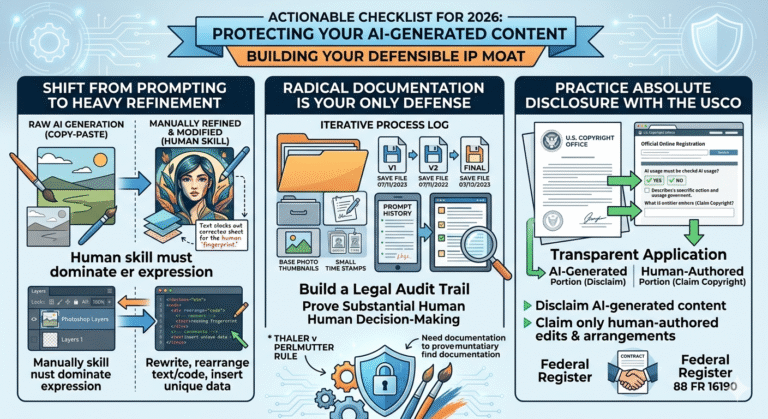
If you’re just copy-pasting raw AI output, you’re scaling your business without a defensible IP moat. To protect your assets under US rules, you must change how you use these tools. Here’s how to create defensible intellectual property when using AI:
1. Shift From Simple Prompting to Heavy Human Refinement
The U.S. Copyright Office is very clear: AI can assist, but the human must create the final expression. That means the AI output should only be your starting point, not the finished product.
For Images: You can’t just generate an image and publish it. To claim copyright, you need to manually edit the work:
- Open the AI image in Photoshop or Illustrator
- Rewrite or redraw sections
- Blend multiple layers
- Use human‑controlled brushes
- Change shapes, lines, textures, or composition
This is the difference between the machine doing the painting versus you doing the creative work.
For Text or Code: Never publish raw AI text. To make it copyright‑eligible:
- Rewrite paragraphs in your own voice
- Change the structure and flow
- Add your own examples, data, or insights
- Adjust the logic of any AI‑generated code
- Make sure your human fingerprint is obvious
This is essential for protecting AI‑assisted content under U.S. copyright law.
2. Radical Documentation Is Your Only Real Defense
If anyone challenges your ownership, you must be able to prove your human creative input. Think of it like building a legal audit trail for your AI‑generated content.
Here’s what to save:
- Your original base photos
- Your hand‑drawn sketches
- Your prompt history
- Multiple versions of your project files
- Dated drafts showing your manual edits
- Screenshots of your editing process
This documentation shows that the final work came from your deliberate human decisions, not just the AI.
If you can’t prove that, the Thaler v. Perlmutter rule kicks in — meaning the work may not qualify for copyright at all.
3. Be Fully Transparent With the U.S. Copyright Office
When you file for copyright, honesty is non‑negotiable. Trying to hide AI involvement is the fastest way to get your registration rejected.
The U.S. Copyright Office requires:
- Clear disclosure of which parts were generated by AI
- A disclaimer for the AI‑generated portions
- A claim only over the human‑authored parts — your edits, selections, and creative arrangement
This comes directly from the Federal Register Copyright Guidance (88 FR 16190).
Transparency protects you. Hiding AI use destroys your claim.
Why Mastering Who Owns AI Generated Content Matters for Creators Like You
Can AI generated content be copyrighted? Yes, but only the human-driven parts. Is AI work in the public domain? Pure output? Absolutely. The human authorship requirement remains ironclad after Thaler v Perlmutter copyright developments and the Copyright Office’s deep dive.
AI is an incredible assistant — your tireless, brilliant intern. But your human vision, curation, editing eye, and unique arrangement? That’s the secret sauce that turns generic output into your protectable asset. That’s where the real economic value lives in 2026 and beyond.
Treat AI as the powerful tool it is. Document like a pro. Create boldly. And protect the human spark that no machine can replicate.
The future rewards creators who ride the wave without getting wiped out by it.