

So, you have built something great — a business name, a catchy slogan, maybe a distinctive logo — and now you want to protect it. Smart move. In Colorado’s competitive market, protecting your brand through trademark registration is one of the most important legal steps a business owner can take. But how exactly does it work? What does it cost? And is a state trademark enough, or do you need to go federal?
This article walks you through everything you need to know about how to register a trademark in Colorado — from the law behind it to the exact steps, with real-world examples and relevant case law to show you why it matters.
What Is a Trademark and Why Does It Matter in Colorado?
A trademark is any word, name, symbol, device, or combination of these that you use to identify your goods or services and distinguish them from competitors. Think of Nike’s swoosh, Apple’s bitten apple, or even the phrase “Just Do It.” Those are trademarks — protected identifiers that belong exclusively to their owners.
Under Colorado Revised Statutes (C.R.S.) § 7-70-101, a trademark is formally defined as “a word, name, symbol, device, or any combination thereof, including packaging, configuration of goods, or other trade dress, used by a person to identify and distinguish the person’s goods or services from those manufactured, produced, or sold by others.”
Here’s an example:
Imagine a Denver coffee roaster using the name “Rocky Mountain Roast.” Without registration, a similar business in another state could adopt a confusingly similar name and expand into Colorado, forcing costly rebranding.
Registering your trademark gives you documented legal proof of ownership and the right to stop others from using confusingly similar marks.
State Trademark vs. Federal Trademark: Which One Do You Need?
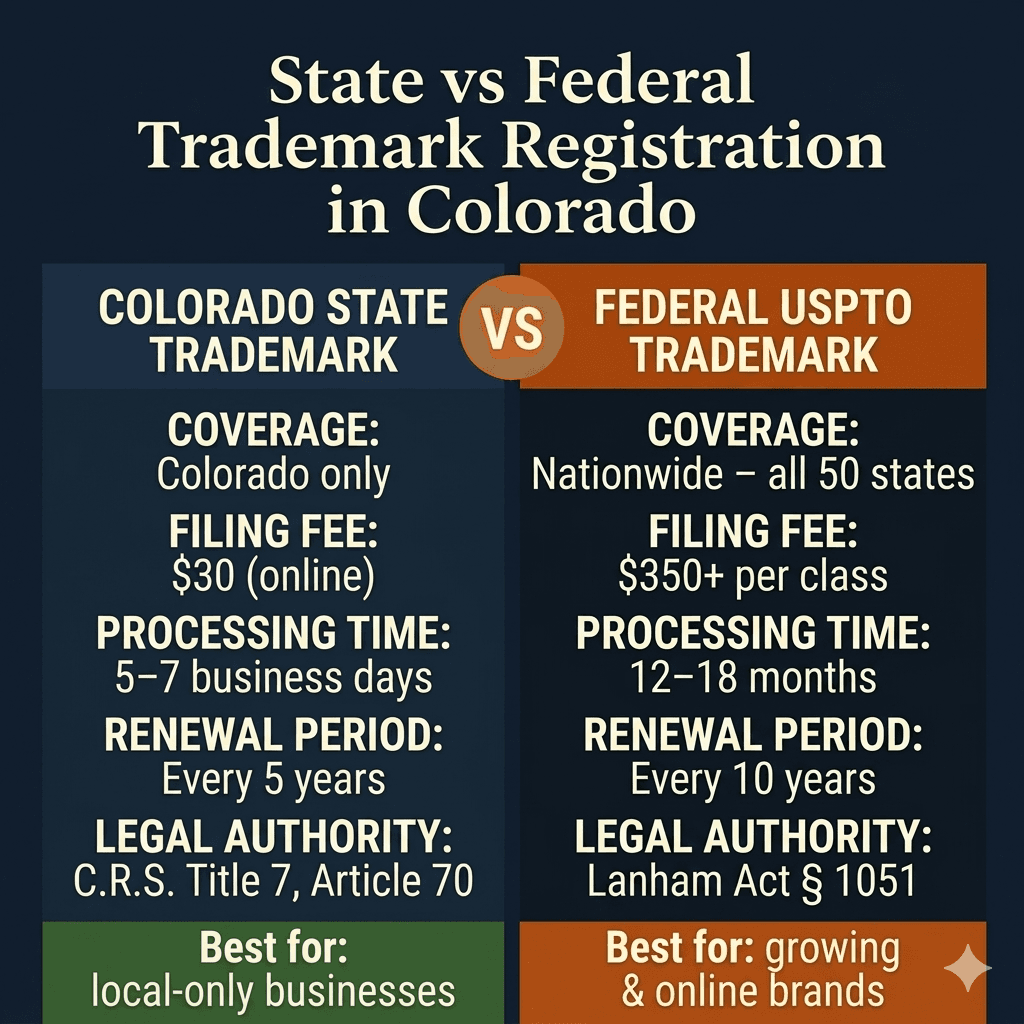
| Aspect | Colorado State Trademark | Federal USPTO Trademark |
|---|---|---|
| Geographic Scope | Protects only within Colorado | Protects nationwide (all 50 states + territories) |
| Best For | Local businesses (restaurants, local services) | Businesses selling online, interstate, or planning national growth |
| Governing Law | C.R.S. Title 7, Article 70 | Lanham Act (15 U.S.C. § 1051 et seq.) |
| Legal Benefits | Public record in Colorado; limited enforcement | Strong legal rights, ® symbol, federal court access, international filings |
| Cost (2026) | $30 online (check current Colorado Secretary of State fee schedule for latest fee) | $350 per class (base fee) |
| Processing Time | Usually 5–7 business days | 12–18 months |
| Strength & Priority | Limited; does not beat federal marks | Stronger; federal registration overrides later state filings |
| Key Limitation | Only protects inside Colorado | Restrictions for cannabis-adjacent products under federal law |
Pro Tip: You can (and sometimes should) file both. Many Colorado businesses start with state registration for immediate local protection while their federal application is pending. However, federal registration supersedes state rights in most cases.
Important Note for Cannabis-Related Businesses: If your business sells cannabis-adjacent products (like hemp rolling papers), federal registration may face restrictions under the Controlled Substances Act. In such cases, state-level registration is often more relevant in Colorado’s legal cannabis market.
Who Can Register a Trademark in Colorado?
Under C.R.S. § 7-70-102(1), any person — individual or business entity — who has actually used a trademark in commerce in Colorado can apply to register it.
This is critical: Colorado requires actual use before you can register. Unlike federal law, which allows “intent-to-use” applications, Colorado does not. You must already be using your mark on goods or services in the state.
Also read: How to Trademark a Business Name in NC (North Carolina) Step by Step – 2026 Guide
Step-by-Step: How to Register a Trademark in Colorado (State Level)
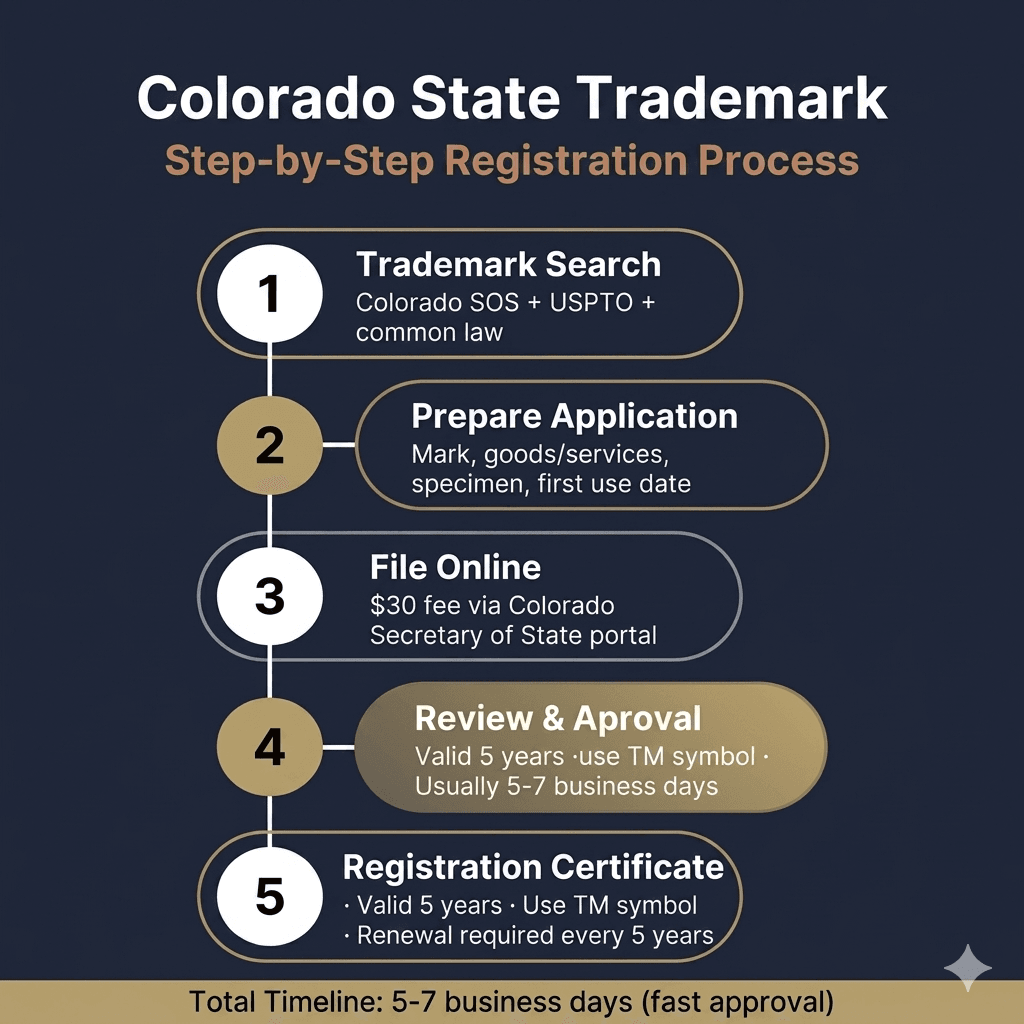
Step 1: Choose and Evaluate Your Mark
Before you file anything, make sure your trademark is actually protectable. Courts and trademark offices evaluate marks along a spectrum of distinctiveness:
- Fanciful marks (invented words like “Kodak” or “Xerox”) — strongest protection
- Arbitrary marks (common words used in unrelated contexts, like “Apple” for computers) — strong protection
- Suggestive marks (hint at the product, like “Netflix”) — protected
- Descriptive marks (describe the product directly) — generally NOT protectable unless they have acquired secondary meaning
- Generic marks (just the name of the product) — never protectable
Example: A Colorado bakery calling itself “Fresh Bread” cannot trademark that name — it’s too descriptive. But “SummitLoaf” as a bakery brand? That’s distinctive and protectable.
Also, a business name registered with the Colorado Secretary of State is not the same as a trademark.
As the Colorado SOS office notes, “A business name is not generally eligible for registration as a trademark, except when the name is used for advertising or placed on goods.”
Step 2: Search for Conflicting Trademarks
Before filing, you must search to make sure no one else already has rights to a similar mark. Search:
- Colorado Secretary of State’s Business Database at sos.state.co.us
- USPTO’s Trademark Electronic Search System (TESS) at uspto.gov
- Common law sources (Google searches, industry directories, domain names)
Skipping this step is one of the costliest mistakes a business owner can make. If you file and your mark conflicts with an existing one, your application will be rejected — and you may face a lawsuit.
Step 3: Prepare Your Application — Know What You Need
Colorado trademark applications are filed electronically through the Colorado Secretary of State’s Business Organizations portal. You will need:
Mark Type — Standard Character or Special Form?
- A standard character trademark consists only of words, letters, or numbers — no specific font, color, or design claimed. Example: the word “SummitRoast” in plain text.
- A special form trademark includes a logo, stylized text, specific colors, or design elements. If your mark has any visual design beyond plain text, it is a special form trademark, and you must attach a drawing or image of it.
Description of Goods or Services
You must provide a detailed description of what your trademark is used for, along with the correct International Classification (Nice Classification) class code — the same system used by the USPTO under 37 C.F.R. § 6.1. There are 45 classes: Classes 1–34 cover goods, Classes 35–45 cover services.
Example: A Colorado software company would file under Class 42 (Scientific and technological services). A clothing brand would file under Class 25.
A Specimen Showing Use in Commerce
A specimen is real-world proof that you are using the mark. For goods, acceptable specimens include a label, tag, packaging, or photo of the mark on the product itself. For services, it could be advertising materials, a website screenshot showing the mark used in connection with the service, or your company letterhead.
Date of First Use in Colorado
You must state the exact date your trademark was first used in Colorado commerce. Per C.R.S. § 7-70-102(2)(j), this date must be in mm/dd/yyyy format.
A Good-Faith Declaration
You must declare in good faith that you have the right to use the mark and that, to your knowledge, your use does not infringe on any other person’s rights — as required by C.R.S. § 7-70-102(2)(k).
Step 4: File the Application Online
Go to the Colorado Secretary of State’s Business Organizations page at sos.state.co.us.
- If your trademark is owned by an existing Colorado business entity: search your business by name or ID, select “File a Form,” then choose “Statement of Trademark Registration of a Reporting Entity.”
- If your trademark is not tied to an existing Colorado business record: select “File a business document,” then “File a form to create a new record,” then register the trademark as an individual.
Processing typically takes 5 to 7 business days.
Step 5: Pay the Filing Fee
Colorado’s trademark filing fee is $30, set by the Colorado Secretary of State’s office. This is significantly lower than federal USPTO fees, which range from $250 to $350 per class as of January 18, 2025. Always check the current Colorado SOS fee schedule at sos.state.co.us before filing, as fees may change
Note: Check the current Colorado SOS fee schedule at sos.state.co.us before filing, as fees are subject to change.
How Long Does a Colorado Trademark Last?
Under C.R.S. § 7-70-104(1), a Colorado trademark registration is effective for five years from the date of filing. To maintain protection, you must file a Statement of Renewal of Trademark Registration within the 180-day window before the expiration date. If that window passes, your trademark expires. Crucially, expired trademarks cannot be renewed — you would have to start over and refile as a new trademark.
What Happens If Someone Infringes Your Colorado Trademark?
Under C.R.S. § 7-70-103, a registered trademark gives the owner constructive notice to the public of their claim — meaning others are legally presumed to know about your mark after registration.
If someone uses a confusingly similar mark for similar goods or services, you can pursue civil remedies including injunctions and damages.
Landmark Case: Two Pesos, Inc. v. Taco Cabana, Inc., 505 U.S. 763 (1992)
One of the most important U.S. Supreme Court trademark cases teaches a vital lesson for Colorado business owners. In this case, Taco Cabana sued Two Pesos for copying the distinctive décor and “trade dress” of its Mexican restaurants.
The Supreme Court ruled that trade dress that is inherently distinctive is protectable without needing to prove that consumers have come to associate it with the brand (what lawyers call “secondary meaning”).
This ruling, under Section 43(a) of the Lanham Act, confirmed that the overall look and feel of your business — not just your name or logo — can be a protectable trademark right. The lesson: your brand’s total image matters, and it can be protected.
This case reinforces why Colorado businesses should take trademark registration seriously from day one — before a competitor copies what you have built.
Common Mistakes to Avoid When Registering a Trademark in Colorado
Business registration ≠ trademark protection Forming an LLC like “Summit Roast LLC” does not give you trademark rights to the name.
Using generic or descriptive names Names like “Colorado Plumbers” can’t be trademarked because they lack distinctiveness.
Skipping the trademark search Filing without searching first can lead to rejection or even legal problems.
Choosing the wrong class Filing in the wrong Nice Class leaves gaps. Example: Clothing = Class 25; Retail services = Class 35.
Missing the renewal deadline Colorado trademarks must be renewed every 5 years, with a 180‑day early renewal window.
Do You Need an Attorney to Register a Trademark in Colorado?
You don’t have to hire an attorney to file a trademark in Colorado.
But trademark law is technical — choosing the right class, writing the goods/services description, and doing a proper trademark search can be confusing.
Even the Colorado Secretary of State recommends hiring a trademark attorney to avoid conflicts and comply with Colorado law.
For simple state trademark filings, many small businesses file on their own.
For federal USPTO trademarks, complex logos, or multi‑class filings, working with an intellectual property attorney is strongly recommended.
Frequently Asked Questions About Colorado Trademark Registration
Generally, a business name alone is not eligible for trademark registration unless it is used in advertising or on goods — for example, the name appears on your product packaging or storefront signage promoting services.
A trademark identifies goods (physical products), while a service mark identifies services. In Colorado, both are registered through the same process under the same statute.
Yes. Under C.R.S. § 7-70-106, a trademark can be transferred to another person or entity. A “Statement of Transfer of Trademark Registration” must be filed with the Secretary of State.
Per C.R.S. § 7-70-101, use in commerce means a bona fide use of the trademark in the ordinary course of trade — not just a token use to claim a right in the mark.
Final Thoughts: Protect Your Brand Before Someone Else Does
Registering a trademark in Colorado is an investment in your business’s future. Start with a state filing for quick local coverage if you’re small and local-only, but prioritize federal USPTO registration for most growing businesses.
Begin with a thorough trademark search, understand state vs federal differences, and use official sources:
- Colorado Secretary of State: sos.state.co.us (for state filings)
- USPTO.gov (for federal applications and Trademark Center)
Don’t wait until a copycat appears. Secure your brand name, logo, or slogan now and focus on what you do best — growing your Colorado business.
Disclaimer: This article provides general information based on official sources and is not legal advice. Trademark law is complex and fact-specific. Consult a qualified Colorado or USPTO-registered trademark attorney for your situation. Laws and fees can change — always verify on official government websites.