
So you’re sitting on a killer formula, a proprietary process, or some seriously valuable business intel — and the one question burning in your brain is: how long are trade secrets protected in US law?
Here’s the short answer: forever — as long as you keep that secret locked down tight.
No registration requirements.
No renewal fees.
No built‑in expiration date under the law. Trade secrets in the US can last indefinitely under both federal and state law — and that’s what makes them the most powerful and underrated form of intellectual property (IP) protection out there.
But — and here’s the part you really need to pay attention to — if the secret leaks, the law stops protecting it. Permanently. No take-backs.
So let’s break down exactly how long trade secrets are protected in US law, when that protection can vanish, and what you need to do to keep your trade secret alive and kicking.
How Long Are Trade Secrets Protected in US Law? The Definitive Answer
Under US federal law — specifically the Defend Trade Secrets Act (DTSA) of 2016 — and under state-level laws based on the Uniform Trade Secrets Act (UTSA), trade secret protection has no fixed expiration date.
The protection lasts as long as ALL three of these conditions are met:
- The information is not publicly known — it’s genuinely secret
- It has independent economic value because of that secrecy
- The owner takes reasonable steps to keep it secret
The USPTO (US Patent and Trademark Office) confirms this directly: the moment any one of these three conditions disappears, the trade secret protection automatically ends — no court order required, no formal process needed. It just evaporates.
Compare that to every other form of IP protection in the US:
IP Protection Type | Duration |
Utility Patent | 20 years from filing date |
Design Patent | 15 years from grant date |
Copyright | Life of author + 70 years |
Trademark | Indefinite (10-year renewal cycles) |
Trade Secret | Indefinite — no expiration as long as secrecy is maintained |
The real-world proof?
Coca-Cola has protected its formula as a trade secret since approximately 1886. That’s nearly 140 years of legal protection — something a 20-year patent could never have delivered. Had they patented it back in the day, the formula would’ve been public domain before your great-grandparents were born.
The Federal Law That Governs How Long Trade Secrets Are Protected in US
The Defend Trade Secrets Act (DTSA) of 2016 — 18 U.S.C. § 1836
Before 2016, companies had to fight trade secret battles in state courts using a patchwork of inconsistent state laws. That all changed when President Obama signed the DTSA into law on May 11, 2016, amending the Economic Espionage Act of 1996.
For the first time in US history, trade secret owners could sue in federal court — a massive deal for companies operating across multiple states.
What the DTSA covers:
- Protection duration: Indefinite — no expiration date built into the law
- Who can sue: Only the owner of the trade secret
- What qualifies: Any information with economic value derived from its secrecy, subject to reasonable protective measures — including financial, business, scientific, technical, economic, or engineering information in any form (tangible or intangible)
- Statute of limitations to file a lawsuit: 3 years from the date of discovery of misappropriation
- Remedies available: Injunctive relief, compensatory damages, punitive damages (up to 2x actual damages for willful misappropriation), and attorney’s fees
The Economic Espionage Act (EEA) of 1996 — 18 U.S.C. §§ 1831–1839
When someone steals a trade secret — we’re talking actual theft, espionage, bribery, hacking — the EEA makes it a federal crime. The penalties are straight-up brutal:
- Individual criminals: Up to 10 years in federal prison + fines up to $500,000
- Corporations: Fines up to $5 million
- Foreign government-sponsored theft: Up to 15 years in prison + corporate fines doubled
The Uniform Trade Secrets Act (UTSA) — State Level
The UTSA is model legislation that 48 states, Washington D.C., Puerto Rico, and the US Virgin Islands have adopted as of 2025. It mirrors much of the DTSA but operates at the state court level. You can sue under both the DTSA and your state’s UTSA version for the same theft — giving you two bites at the legal apple.
When Does Trade Secret Protection END? (The Part Nobody Tells You)
Here’s the thing about how long trade secrets are protected in US: the clock doesn’t run out on a calendar date — it runs out when you let it. Here are every way protection can be lost:
- The Secret Becomes Public Knowledge
Once information enters the public domain — through leaked documents, a media report, a patent publication, or any public disclosure — it’s no longer a trade secret. Game over. You can’t un-ring that bell.
- You Stop Protecting It (Biggest Mistake Businesses Make)
No NDAs? Employees sharing passwords? Confidential files stored on unsecured servers? Courts will find you failed to take “reasonable measures” — and that ends your protection even if the secret itself hasn’t leaked yet.
In Fujikura Composite Am., Inc. v. Dee (S.D. Cal. 2024), the court found that companies with non-disclosure agreements, locked buildings, visitor sign-in procedures, restricted access areas, and secure file servers likely had sufficient protections. No such measures? No trade secret protection.
- Independent Discovery by a Competitor
If a competitor figures out your trade secret through their own legit research and development — no improper means, no breach of contract — that’s 100% legal under US law. Their independent discovery doesn’t destroy your trade secret against everyone else, but it does mean you can’t stop that particular competitor from using what they figured out on their own.
- Reverse Engineering
Someone buys your product off the shelf, tears it apart, and figures out how it works — that’s generally fair game in the US. Reverse engineering is a lawful method of obtaining trade secrets. Unless you have a contractual agreement preventing it, you can’t stop this.
- Accidental Disclosure in Legal Proceedings
Court cases can get messy. Sometimes confidential information gets disclosed in depositions, exhibits, or public filings in ways that strip away secrecy. The DTSA includes provisions allowing companies to file documents under seal to try to prevent this — use them.
The 3-Year Statute of Limitations: Don't Sleep on Your Rights
Here’s a critical distinction: while how long trade secrets are protected in US law is indefinite, how long you have to sue someone for stealing your trade secret is not.
Under the DTSA and most state UTSA versions, you have exactly 3 years from the date you discovered — or reasonably should have discovered — the misappropriation to file a lawsuit in court.
Blow past that deadline? You’re done. Doesn’t matter how clearly your secret was stolen.
The Discovery Rule: Courts apply what’s called the “discovery rule.” The 3-year clock starts ticking when you knew or should have known about the theft — not necessarily when you found the smoking gun. If red flags were everywhere and you ignored them, a court can rule you’re too late to sue even if you claim you only “just found out.”
Bottom line: The moment you suspect trade secret theft, get a lawyer on the phone. Don’t wait.
Landmark Case Law: Real Courts, Real Money, Real Stakes
Waymo LLC v. Uber Technologies, Inc. (Settled 2018)
Former Waymo engineer Anthony Levandowski allegedly downloaded more than 14,000 confidential files related to self-driving car technology before jumping ship to start his own company, which Uber acquired. Uber settled for $245 million in equity plus a commitment not to use the stolen tech. One of the highest-profile trade secret cases in Silicon Valley history.
Motorola Solutions v. Hytera Communications (2020)
A federal jury hit Hytera with a $407.4 million verdict after finding they stole Motorola’s trade secrets related to two-way digital radio technology by poaching Motorola engineers who brought proprietary code and documentation with them.
Insulet Corp. v. EOFlow Co. (2024)
One of the largest trade secret verdicts in US history — $452 million — was handed down against EOFlow for misappropriating trade secrets tied to Insulet’s OmniPod insulin pump technology. This case alone proves just how financially devastating trade secret theft can be for the thief.
Computer Sciences Corp. v. Tata Consultancy Services (2023)
TCS was hit with a $210 million award for trade secret misappropriation. Another data point in a clear trend: jury verdicts in trade secret cases are getting bigger every year.
Metron Nutraceuticals, LLC v. Cook (6th Cir. 2024)
The Sixth Circuit clarified that trade secret information must be unique and competitively advantageous to qualify for protection. It’s not enough for information to merely be novel in a patent-law sense — it must actually derive economic value from not being generally known. This is a key threshold test courts apply.
What "Reasonable Measures" Actually Means
Courts won’t hand you a checklist, but 2024–2025 case law has made it crystal clear what’s expected. Here’s what you need in place to maintain protection:
Legal safeguards:
- NDAs (Non-Disclosure Agreements) with every employee, contractor, vendor, and business partner who touches confidential info
- DTSA whistleblower immunity notice in every NDA — required by federal law to pursue punitive damages
- Clear confidentiality designations on sensitive documents
Technical safeguards:
- Role-based access controls — not everybody needs access to everything
- Encrypted file storage and password-protected systems
- Access logs that show who viewed what and when
Physical safeguards:
- Locked facilities and restricted access areas
- Visitor sign-in procedures
- Security cameras in sensitive areas
Operational safeguards:
- Regular employee training on what’s confidential and how to handle it
- Formal exit interview procedures with written reminders of ongoing confidentiality obligations
- Periodic trade secret audits to identify what needs protecting
In BlueLinx Corp. v. Edwards (N.D. Tex. 2024), the court drove home that proving reasonable safeguards is absolutely critical to establishing valid trade secret status in litigation. No measures documented = no trade secret.
Common Ways Trade Secrets Lose Protection—And How to Avoid Them
Most articles list the basics, but here’s what many miss: time-limited NDAs can accidentally kill your trade secret status.
Courts have ruled that signing NDAs with fixed expiration dates (e.g., “confidentiality obligations end after 5 years”) can demonstrate you didn’t take reasonable measures to protect secrecy. Key examples:
D.B. Riley, Inc. v. AB Engineering Corp. (D. Mass. 1997) — A 10-year NDA term helped sink the plaintiff’s claim because it signaled the owner expected secrets to become non-confidential after that period.
Silicon Image, Inc. v. Analogk Semiconductor, Inc. (N.D. Cal. 2008) — Fixed-term NDAs undermined “eternal vigilance” over the secrets.
Pro tip: Always include a survival clause stating that trade secret obligations continue “for as long as the information remains a trade secret under applicable law,” regardless of the NDA’s overall term.
Other common killers:
- Accidental public disclosure (e.g., employee posts on LinkedIn).
- Failure to mark documents as “Confidential.”
- Insufficient controls in the age of remote work and AI tools.
Trade Secrets vs. Patents: Which Protects You Longer?
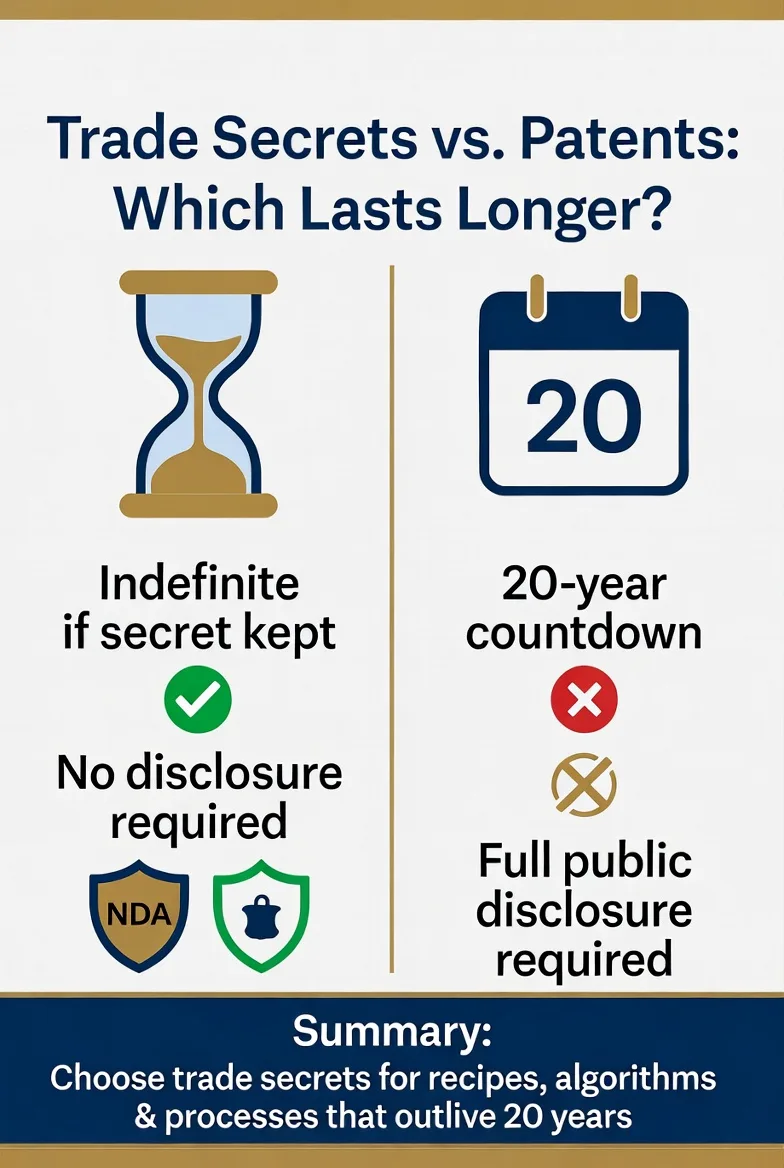
Since we’re talking about how long trade secrets are protected in US versus other IP forms, let’s settle this head-to-head:
Go with a Trade Secret when:
- You can realistically maintain secrecy long-term
- The competitive advantage will outlast a 20-year patent window
- You don’t want competitors learning how your product works through a public patent filing
- You want to avoid patent prosecution costs, maintenance fees, and invalidity challenges
Go with a Patent when:
- Reverse engineering is easy — competitors will figure it out anyway
- You need to publicly license the technology for revenue
- You operate in an industry where patent portfolios signal credibility to investors
- The commercial window is under 20 years
Key trend: Since the Supreme Court’s Alice Corp. v. CLS Bank International (2014) decision made it significantly harder to patent software inventions, tech companies have dramatically shifted toward trade secret protection for algorithms, AI models, and software processes. This trend is accelerating in 2025.
How to Maximize Your Trade Secret Lifespan: Actionable Steps
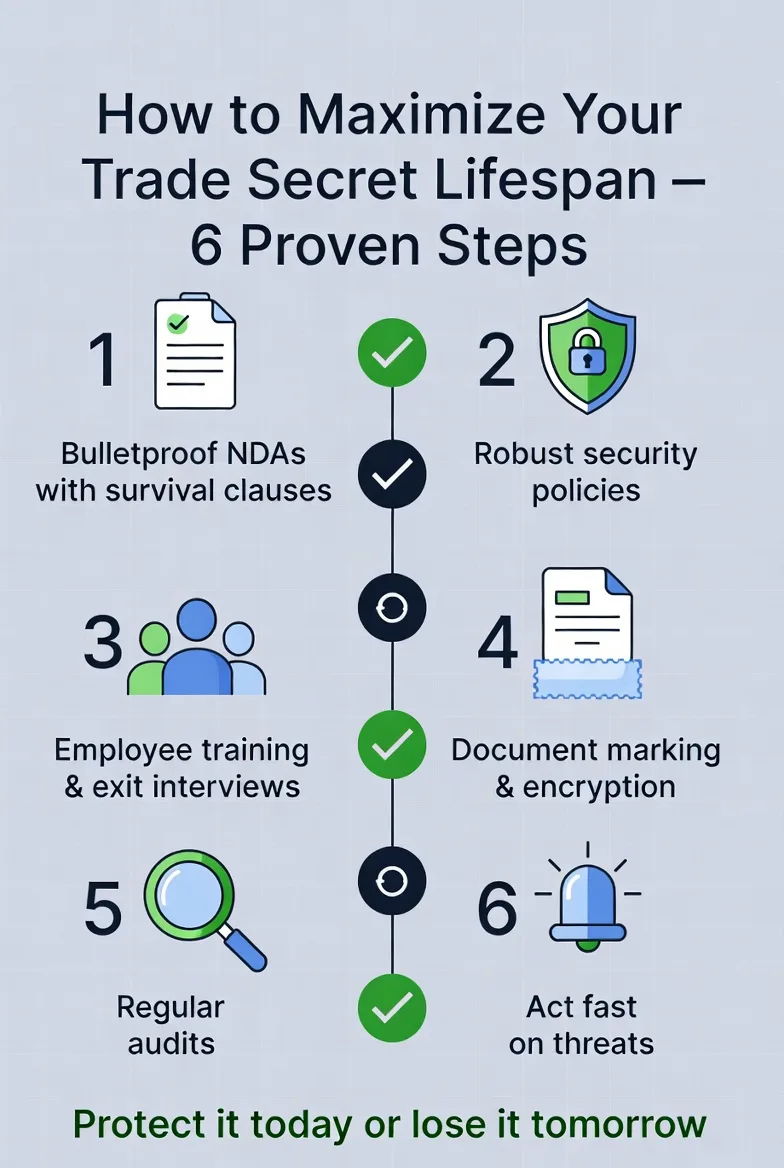
Want your secrets to outlast the competition? Do this:
- Draft bulletproof NDAs with perpetual trade secret survival clauses.
- Implement robust policies—access logs, exit interviews, need-to-know restrictions, and annual training.
- Use technology wisely—watermark documents, monitor AI tools that could leak data, and encrypt everything.
- Audit regularly—review what still qualifies as a secret.
- Act fast on threats—the DTSA’s 3-year statute of limitations starts when you discover (or should have discovered) misappropriation.
Recent 2025 data shows federal trade secret filings hit record highs (over 1,500 cases), driven partly by AI and employee mobility. Proactive protection pays off.
Frequently Asked Questions: How Long Are Trade Secrets Protected in US?
No. Trade secret protection in the US lasts indefinitely under the DTSA and state UTSA laws, as long as the information remains secret, has economic value from that secrecy, and is subject to reasonable protective measures.
No. Unlike patents (20 years) or copyrights (life + 70 years), trade secrets have no built-in expiration date. They expire only when the conditions for protection are no longer met.
Under the DTSA, you have 3 years from the date you discovered — or reasonably should have discovered — the misappropriation. Most state UTSA versions use the same 3-year window.
Yes — dramatically longer. A patent lasts 20 years maximum. A trade secret can last forever. Coca-Cola’s formula has been a trade secret for nearly 140 years.
Once information enters the public domain, trade secret protection is automatically and permanently lost with no way to reclaim it.
Yes. Independent discovery and reverse engineering are both lawful ways to obtain trade secrets in the US. Only improper means (theft, espionage, breach of confidence) trigger legal liability.
Bottom Line: How Long Are Trade Secrets Protected in US?
Indefinitely. Forever. No expiration date — as long as you protect them.
That’s the law under the Defend Trade Secrets Act (DTSA), 18 U.S.C. § 1836, the Economic Espionage Act of 1996, and the Uniform Trade Secrets Act adopted by 48 states. No registration required. No government fees. No renewal paperwork.
But “indefinite” protection is not “automatic” protection. The US legal system doesn’t babysit your secrets. It only protects the ones you’re actively working to keep secret — through NDAs, access controls, employee training, physical security, and documented policies.
The 2024 verdict data tells the real story: $452 million. $407 million. $245 million. $210 million. Courts are taking trade secret cases more seriously than ever, and jury awards are at historic highs. The stakes — for victims and thieves alike — have never been higher.
How long are trade secrets protected in US? As long as you deserve that protection. Keep the secret. Keep the shield.
This article is for general informational purposes only and does not constitute legal advice. Always consult a licensed intellectual property attorney for guidance specific to your situation.