
Protecting your brand name in California is one of the most important legal steps you can take as a business owner — and one of the most misunderstood. Many entrepreneurs think registering a business name with the state gives them trademark rights. It doesn’t.
This guide covers everything you need to know about how to trademark a business name in California in 2026 — including accurate, officially sourced fees, the exact filing process, the difference between state and federal protection, and the critical mistakes that get applications rejected.
Trademark vs. Business Name Registration in California
This is the single most important distinction California business owners need to understand:
Registering a business name (LLC, corporation, or DBA) with the California Secretary of State does NOT give you trademark rights. It only reserves the name for corporate filing purposes within the state’s business entity database.
A trademark, by contrast, gives you the exclusive legal right to use a name, logo, or slogan in commerce in connection with specific goods or services — and the legal standing to stop others from using the same or confusingly similar mark.
Without a registered trademark:
- A competitor can legally use your business name in California (or nationwide) even if you registered first with the Secretary of State
- You have limited legal recourse without costly common law trademark litigation
- You cannot use the ® symbol (reserved for federally registered marks)
- You have no automatic protection on platforms like Amazon Brand Registry or Etsy
California State Trademark vs. Federal USPTO Trademark
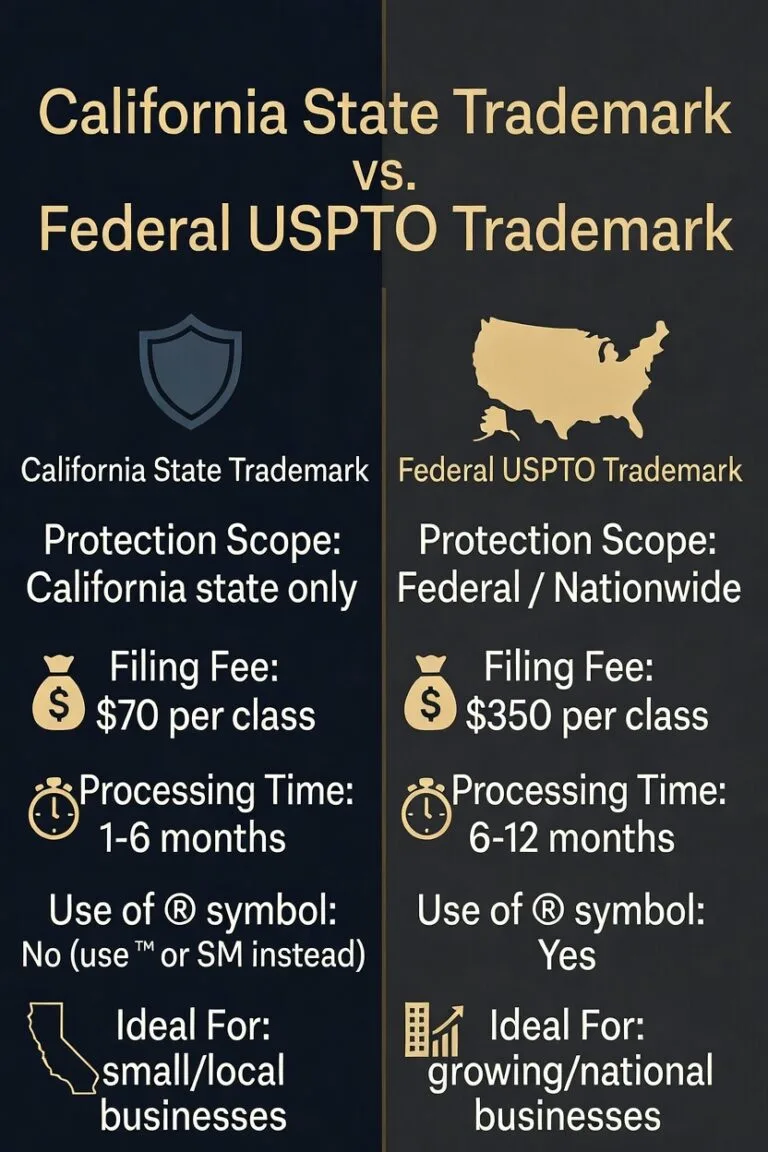
You have two paths to trademark protection: registering with the California Secretary of State (state-level) or with the U.S. Patent and Trademark Office (USPTO) (federal-level). Here’s how they compare:
Which Should You Choose?
- Choose a California state trademark if you operate exclusively in California, want faster and lower-cost protection, and are not currently selling online to customers in other states.
- Choose a federal USPTO trademark if you sell online, operate in multiple states, plan to scale nationally, or want the strongest possible legal protection.
Many businesses do both — starting with state registration for speed, then filing federally as they grow.
Official Fees for Trademarking in California (2026)
California State Trademark Fees (2026)
These fees are confirmed by the California Secretary of State’s official website:
- Filing fee: $70.00 per classification code per mark
- Renewal fee (every 5 years): $30 per classification code
Note: Trademarks (goods, Classes 1–34) and Service Marks (services, Classes 35–45) must be filed on separate applications, each with separate fees.
Federal USPTO Trademark Fees (2026)
As of January 18, 2025, the USPTO consolidated its filing system into a single base application with potential surcharges:
- Base application fee: $350 per class (Sections 1 and 44 applications)
- Insufficient information surcharge: +$100 per class (if required fields are incomplete)
- Free-form ID surcharge: +$200 per class (if goods/services descriptions are not from the Trademark ID Manual)
- Excess character surcharge: +$200 per additional 1,000 characters beyond the first 1,000
- Statement of Use / Amendment to Allege Use: $150 per class
- Section 9 renewal: $350 per class
Tip: To avoid surcharges on federal applications, use pre-approved identifications from the USPTO’s Trademark Identification (ID) Manual when describing your goods and services.
Additional Cost Estimates
Cost Item | Estimated Range |
California state filing fee | $70 per class |
Federal USPTO filing fee | $350+ per class |
Professional trademark search | $300–$1,000+ |
Trademark attorney fees | $150–$500/hour (varies) |
Minimum cost (CA state, 1 class, DIY) | $70 |
Step-by-Step: How to Trademark a Business Name in California
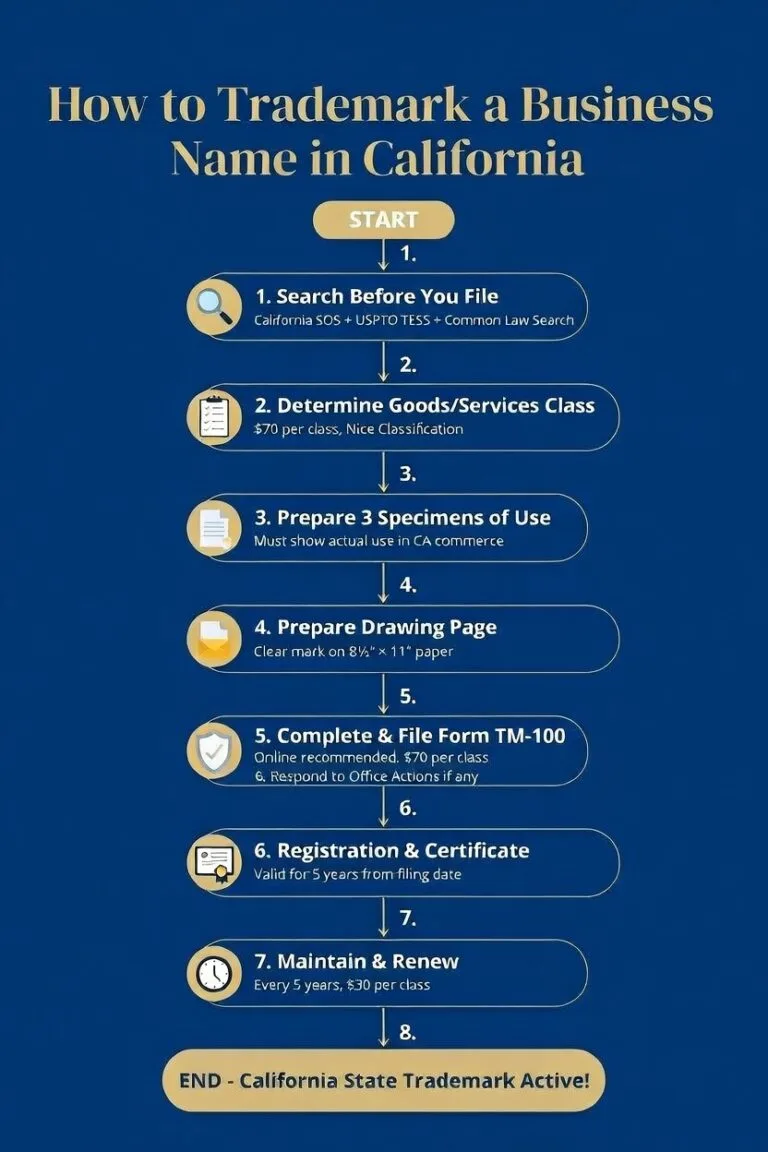
Step 1: Search Before You File
This is the most critical step — and the one most people skip. Filing without a proper search risks rejection, wasted fees, and potential infringement liability.
Conduct searches across three layers:
- California Secretary of State Trademark Search Use the free California Trademark Search tool to check for identical marks already registered in California.
- USPTO Trademark Electronic Search System (TESS) Search the federal database at USPTO TESS for marks registered or pending nationwide. A California state search alone is not sufficient — a federally registered mark in the same class can block your use even within California.
- Common Law Search Search Google, social media platforms (Instagram, Facebook, TikTok), Amazon, Etsy, and domain registrars. Common law trademark rights arise from use in commerce even without registration — and can be asserted against you.
Important: The California Secretary of State’s office does not conduct an in-depth search for confusingly similar marks as part of its examination. It primarily reviews formal requirements. You are responsible for identifying conflicts.
Step 2: Determine Your Goods or Services Classification
California uses the international Nice Classification system — the same 45 classes used by the USPTO:
- Classes 1–34: Goods (physical products)
- Classes 35–45: Services
You must correctly identify every class that applies to your business. Each class requires a separate $70 filing fee. Choosing the wrong class can result in a rejected application or inadequate protection.
Key rule: Trademarks (goods) and Service Marks (services) must be filed as separate applications in California — you cannot combine them on one form.
Step 3: Prepare Your Three Specimens of Use
California requires three (3) identical original specimens showing how the mark is currently being used in commerce in California. Acceptable specimens include:
- Product labels or tags showing the mark
- Packaging with the mark visible
- Screenshots of a website displaying the mark with pricing and purchasing information
- Photographs of the mark displayed in a business location
- Advertisements showing the mark in connection with the goods/services
Critical: You must already be using the mark in commerce in California at the time of filing. California does not accept intent-to-use applications.
Step 4: Prepare Your Drawing Page
You must submit a drawing of your mark on a plain 8½” × 11″ sheet of paper. The drawing:
- May be hand-written, hand-drawn, or computer-generated
- Must show the mark clearly
- If your mark is word-only, write only those words
- Photocopies of the mark are not acceptable
- If any part of the mark is not in English, include a certified English translation
Step 5: Complete and File Form TM-100
Form TM-100 is the official California Trademark/Service Mark Application for Registration.
What you need to include:
- Full legal name and business address of the mark owner
- Business structure (individual, LLC, corporation, partnership, etc.)
- A clear description of the mark
- The specific goods or services the mark is used with
- International classification code(s)
- Date of first use anywhere and date of first use in California
- Design code (if your mark includes a design element)
- Three identical specimens
- Drawing page
- Declaration of Accuracy (required by law — false statements carry penalties up to $10,000)
- Filing fee of $70 per classification
Filing options:
Method | Priority |
Online (recommended) via TMbizfile.sos.ca.gov | Stamped at exact date and time received |
In Person at Sacramento office | Stamped at exact date and time received |
By Mail to: Secretary of State, Trademark Unit, P.O. Box 942870, Sacramento, CA 94277-2870 | Stamped at 5:00 p.m. on date received |
Filing online is strongly recommended. Applications are processed on a first-come, first-served basis based on the exact date and time received. Mail applications receive a 5:00 p.m. timestamp regardless of when in the day they arrive, putting you at a disadvantage if competing applications are filed the same day.
Step 6: Respond to Office Actions (If Issued)
The California Secretary of State’s Trademark Unit examines your application for formal compliance — including whether the mark is merely descriptive, whether the specimen properly shows use in commerce, and whether goods/services are correctly identified.
If any issues are found, you will receive an Office Action — an official notice requesting corrections or additional information. You must respond within the specified deadline (typically 30 days) or your application will be abandoned.
Common reasons for Office Actions in California:
- Specimens do not adequately show the mark in use in commerce
- Mark is merely descriptive of the goods/services
- Incorrect classification of goods or services
- Missing or incorrect drawing page
- Incomplete declaration
Step 7: Registration and Certificate
Once your application is approved, your trademark is registered with the California Secretary of State. You will receive an official certificate of registration.
Your registration is active for five (5) years from the date filed — not from the date of approval.
Step 8: Maintain and Renew Your Registration
- Renewal window: Within 6 months before the 5-year expiration date
- Renewal fee: $30 per classification
- Ongoing requirement: The mark must be in continual use in commerce to be eligible for renewal
- You can renew every 5 years indefinitely as long as the mark remains in use
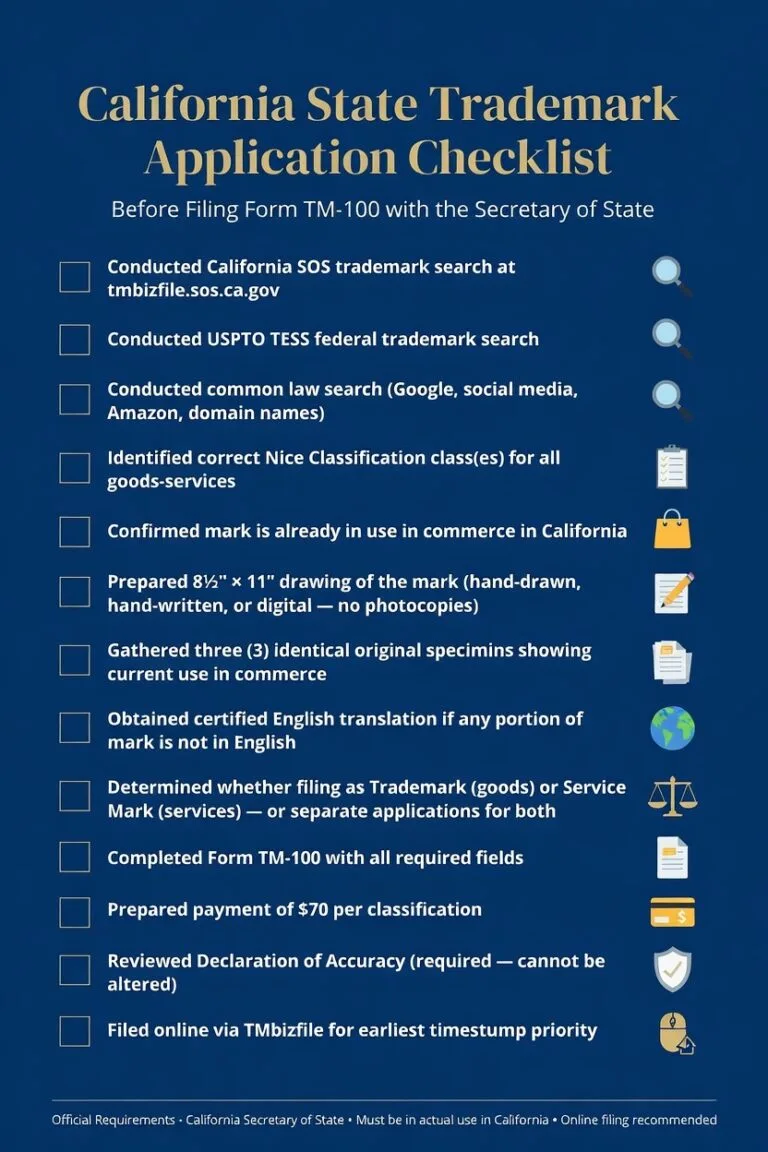
What You Need Before You File (2026 Checklist)
Use this checklist before submitting your California trademark application:
Common Mistakes That Get California Trademark Applications Rejected
- Not Doing a Full Search:
California doesn’t check for similar marks, so skipping a USPTO search can lead to infringing a federal trademark even if your state mark is approved.
- Filing Before Actual Use:
California requires real, in‑commerce use of the mark; intent‑to‑use filings aren’t allowed.
- Incorrect Specimens:
You must submit three identical real‑world specimens — not mock-ups or variations.
- Combining Goods and Services:
If your mark covers both goods and services, you need two separate applications and fees.
- Wrong Class Selection:
Filing in the wrong class leaves your mark unprotected in the correct category and may cause rejection.
- Overestimating State Protection:
A California registration protects only within the state and doesn’t override federal rights.
- Misusing ®:
You can only use ® after federal registration; state registration allows only ™ or ℠.
- Missing Renewal Deadline:
Renewal must occur within the 6‑month window before the 5‑year expiration — no grace period exists.
Benefits of Trademark Registration for California Small Businesses
| Feature | California State Trademark | Federal USPTO Trademark |
|---|---|---|
| Protection Scope | Limited to California only | Nationwide (all 50 states) |
| Filing Fee | $70 per class | $350 per class |
| Processing Time | 1-6 months | 6-12 months |
| Use of ® Symbol | No (use ™ or SM instead) | Yes (after registration) |
| Right to Use ™ / SM | Yes | Yes |
| Priority | Priority over later California filings | Nationwide priority |
| Public Notice | Yes (in California) | Yes (nationwide) |
| Legal Presumption of Ownership | Within California | Nationwide (incontestable after 5 years) |
| Customs Recording | No | Yes (block counterfeit imports) |
| Platform Protection | Limited | Yes (Amazon Brand Registry, Etsy, etc.) |
| International Basis | No | Yes (Madrid Protocol) |
| Ideal For | Small/local businesses operating only in California | Growing or national businesses |
Important Notes:
- California State Trademark offers fast and affordable protection but only within California.
- Federal USPTO Trademark provides much stronger, nationwide protection and additional legal benefits.
- Fees and processing times are approximate and based on official guidelines from the California Secretary of State and USPTO.
Frequently Asked Questions (FAQs)
For a California state trademark, the process typically takes anywhere from a few weeks to several months, depending on the current workload of the Secretary of State’s Trademark Unit and whether any Office Actions are issued.
For a federal USPTO trademark, the current timeline from filing to first examination is approximately 6–9 months, with total registration taking 12–18+ months if no complications arise.
Only if your use in commerce predates theirs, or you can demonstrate superior rights through a prior registration or agreement. Filing a trademark application does not guarantee registration — and registration does not guarantee exclusive ownership if another party has prior common law rights.
No — there is no legal requirement to use an attorney for California state trademark applications. The process is designed to be accessible to individuals and businesses filing on their own.
However, an attorney is strongly recommended if:
- Your mark is complex or includes design elements
- You are planning to file federally with the USPTO
- Your search reveals potentially conflicting marks
- You have received an Office Action
- You are scaling nationally or internationally
Trademark protects brand identifiers — names, logos, slogans, and other marks used in commerce to distinguish your goods or services from others.
Copyright protects original creative works — written content, art, music, software code, photographs, and similar works.
They are separate legal protections and often both apply to different aspects of a business.
Yes. Federal trademark protection is available to any business engaged in commerce that can affect interstate trade — which includes online businesses, even those based solely in California. If you sell products or services online to customers in other states, you likely qualify for federal registration and should strongly consider it.
Your registration expires, and you lose the legal benefits of registration. Another party could then file for the same or similar mark. You would need to file a new application (not a renewal) if you wish to re-register.
Legal Disclaimer
This information is for general educational purposes only and is not legal advice. Trademark laws, steps, fees, and processing timelines — including those for California trademark registration — can change at any time. Your situation may require different steps depending on your specific facts. For help with trademark filings, infringement issues, or any legal questions, you should speak with a qualified attorney licensed in your area.

Dr. Shahnaz Kaushar, PhD in Intellectual Property Rights
I’m a content writer and intellectual property rights specialist with over a decade of experience. I hold LL.B, LL.M, and a PhD in IPR, have taught IP law at the academic level, and have worked with a leading law firm in Dubai on brand protection and trademark matters. I use my legal background to create clear, easy‑to‑understand content that helps business owners protect their ideas.